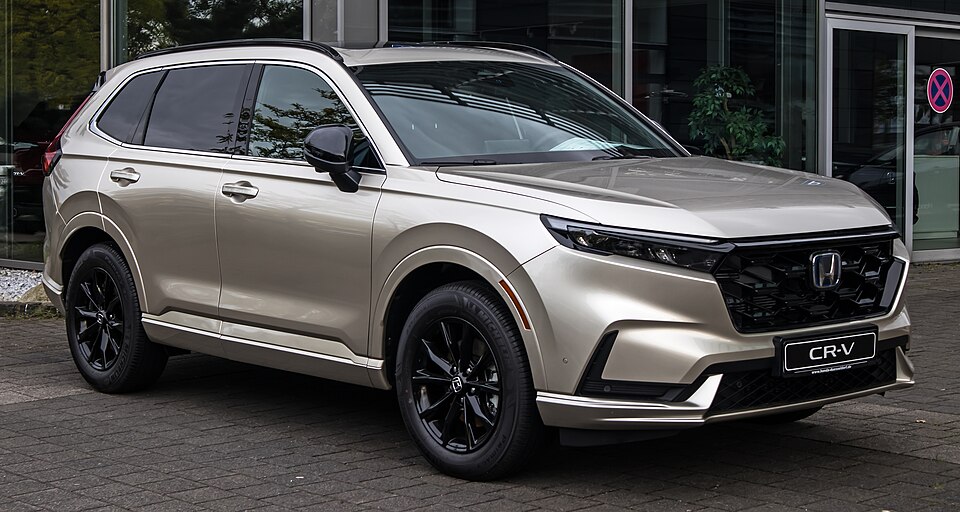
2017 Honda CR-V
Gas Compact SUV
The 2017 Honda CR-V is sold in the U.S. as a gas compact SUV with 4 EPA-rated configurations. The most efficient version, the CR-V FWD, is EPA-rated at 30 mpg combined. NHTSA lists 7 recall campaigns for this model year, 1 rated critical, which gives it a Safety Signal grade of F. Owners have filed 1761 complaints, most often about engine. NHTSA crash-tested it at 5 stars overall.
Specs & fuel economy (EPA)
| Configuration | Powertrain | Drive | Engine / motor | City | Hwy | Comb | Annual fuel* |
|---|---|---|---|---|---|---|---|
| CR-V FWD | Gas | FWD | 1.5L 4-cyl turbo | 28 | 34 | 30 | $2,100 |
| CR-V AWD | Gas | AWD | 1.5L 4-cyl turbo | 27 | 33 | 29 | $2,150 |
| CR-V FWD | Gas | FWD | 2.4L 4-cyl | 26 | 32 | 28 | $2,250 |
| CR-V AWD | Gas | AWD | 2.4L 4-cyl | 25 | 31 | 27 | $2,300 |
*EPA estimate at 15,000 miles/year and EPA reference fuel/electricity prices. Source: fueleconomy.gov vehicle records.
Out of factory warranty soon?
The 2017 Honda CR-V is in the years where transmission, electronics and drivetrain repairs land on the owner. Compare extended-coverage quotes in about two minutes.
Compare coverage →Affiliate disclosure: some links on this page are affiliate links. If you request a quote or buy through them we may earn a commission at no extra cost to you. Data on this page is never influenced by that.
Recalls (7)
Air Bags
highProblem: Honda (American Honda Motor Co.) is recalling certain 2018-2021, 2023 Acura TLX, 2019-2024 RDX, 2017-2020, 2022-2026 MDX, 2017-2021, 2023, 2025 Honda Ridgeline, 2017-2022 Pilot, 2019-2021 Passport, 2018-2026 Odyssey, 2019-2022 Insight, 2019-2021 HR-V, 2018-2020 Fit, 2020-2022 CR-V Hybrid, 2017-2022 CR-V, 2017-2018, 2021 Civic Type R, 2017-2021 Civic hatchback, 2016-2020 Civic coupe, 2016-2022 Civic, 2017-2022 Accord Hybrid, and 2016-2022 Accord vehicles. The front passenger seat weight sensor may crack and short circuit, which can cause the air bags to deploy unintentionally during a crash.
Risk: Air bags that deploy unintentionally during a crash increase the risk of injury.
Fix: Dealers will replace the seat weight sensors, free of charge. Owner notification letters were mailed July 7, 2026. Owners may contact Honda's customer service at 1-888-234-2138. Honda's numbers for this recall are BOL, WO9, OOA, WOM, XOH, NOC, POD, BOE, UOF, POB, EOG, AOI, QO8, TOJ, DO7, and SOK. This recall expands previous NHTSA recall number 24V064. Vehicle Identification Numbers (VINs) involved in this recall will be searchable on NHTSA.gov beginning May 29, 2026.
Fuel System, Gasoline
highProblem: Honda (American Honda Motor Co.) is recalling certain 2013-2023 Honda Accord, Civic Coupe, Civic Sedan, Civic Hatchback, Civic Type R, CR-V, HR-V, Ridgeline, Odyssey, Acura ILX, MDX, MDX Hybrid, RDX, RLX, TLX, 2019-2022 Honda Insight, Passport, 2020 Honda CR-V Hybrid, 2018-2019 Honda Clarity PHEV, Fit, and 2015-2020 Honda Accord Hybrid, Pilot, Acura NSX vehicles. The fuel pump inside the fuel tank may fail.
Risk: Fuel pump failure can cause an engine stall while driving, increasing the risk of a crash.
Fix: Dealers will replace the fuel pump module, free of charge. Owner letters were mailed September 6, 2024. Owners may contact Honda customer service at 1-888-234-2138. Honda's numbers for this recall are KGC and KGD. This recall is an expansion of NHTSA recall numbers 21V-215 and 20V-314.
Equipment
minorProblem: Honda (American Honda Motor Co.) is recalling certain 2017, 2020, and 2022 CR-V vehicles. The certification label on the driver's side door states incorrect Gross Vehicle Weight Rating (GVWR), Gross Axle Weight Rating (GAWR), and tire size information. As such, these vehicles fail to comply with the requirements of Federal Motor Vehicle Safety Standard number 110, "Tire Selection and Rims."
Risk: An incorrectly sized tire may cause premature tread wear, or a tire blow out, increasing the risk of a crash.
Fix: Dealers will install a new corrected label, free of charge. Owner notification letters were mailed September 18, 2023. Owners may contact Honda customer service at 1-888-234-2138. Honda's number for this recall is CF7.
Seat Belts
highProblem: Honda (American Honda Motor Co.) is recalling certain 2017-2020 CR-V, 2018-2019 Accord and Accord Hybrid, 2018-2020 Odyssey, 2019 Insight, and 2019-2020 Acura RDX vehicles. A manufacturing issue with the front seat belts may cause the seat belt buckle channel to interfere with the release button, preventing the seat belt buckle from latching.
Risk: An unlatched seat belt cannot properly restrain the seat occupant during a crash, increasing their risk of injury.
Fix: Dealers will replace the driver and front passenger seat belt buckle release buttons or the buckle assemblies as necessary, free of charge. Owner notification letters were mailed April 18, 2023. Owners may contact Honda customer service at 1-888-234-2138. Honda's numbers for this recall are NDA, QDB, BDC, MDD, LD9. TDF, FDG, ODH, YDI, ZDE.
Steering
highProblem: Honda (American Honda Motor Co.) is recalling certain 2017-2018 Honda Civic and CR-V vehicles. The magnet that controls the torque sensor output signal for the electronic power steering system may not be properly secured, allowing the magnet to become dislodged. During a full lock turn, the dislodged magnet may cause steering assist to be applied in the opposite direction.
Risk: The unintended steering input reduces vehicle maneuverability and increases the risk of a crash.
Fix: Honda will notify owners, and dealers will replace the steering gearbox assembly, free of charge. The recall began November 9, 2018. Owners may contact Honda customer service at 1-888-234-2138. Honda's numbers for this recall are C2N, P2O.
Fuel System, Gasoline
criticalProblem: Honda (American Honda Motor Co.) is recalling certain 2017 Honda CR-V 2WD and AWD vehicles. The affected vehicles have a fuel supply pipe that may have been improperly manufactured, possibly resulting in the pipe disconnecting and leaking while driving.
Risk: If the pipe disconnects, the engine will stall, increasing the risk of a crash. Additionally, the disconnected pipe may leak fuel, which, in the presence of an ignition source, can increase the risk of a fire.
Fix: Honda will notify owners, and dealers will replace the fuel supply pipe, free of charge. The recall began August 31, 2017. Owners may contact Honda customer service at 1-888-234-2138. Honda's number for this recall is KH1.
Equipment
minorProblem: Honda (American Honda Motor Co.) is recalling certain 2017 CR-V and Acura RDX vehicles. The Certification Labels on the affected vehicles were printed with ink that may be inadvertently wiped away with an alcohol solvent. As such, these vehicles fail to comply with the requirements of 49 CFR Part 567, "Certification."
Risk: If the label information can be wiped away, the operator may not be able to refer to the information, possibly resulting in the vehicle being overloaded, which can increase the risk of a crash.
Fix: Honda and Acura will notify owners, and dealers will replace the Certification Label, free of charge. The recall began June 2017. Owners may contact Honda customer service at 1-888-234-2138. Honda's numbers for this recall are KF3 (CR-V)and KF4 (RDX).
NHTSA investigations
Forward Collision Avoidance:Software — Inadvertent Automatic Emergency Braking (open)
On February 21, 2022, the Office of Defects Investigation (ODI) opened Preliminary Evaluation (PE22003) to assess reports of inadvertent activation of the Collision Mitigation Braking System (CMBS), an automatic emergency braking (AEB) system, in model year 2017-2019 Honda CR-V and 2018-2019 Honda Accord vehicles. The reports allege that activation of the AEB system occurs while driving with no apparent obstruction in the vehicle's forward path, resulting in sudden vehicle deceleration. Honda indicated that they were aware of a total of X,XXX reports that may relate to the alleged defect. Honda provided analysis of the alleged defect and alleges that some customers possibly had an inadequa
Opened Apr 15, 2024 · action EA24002
Forward Collision Avoidance:Software — Inadvertent Automatic Emergency Braking (closed)
On February 21, 2022, the Office of Defects Investigation (ODI) opened Preliminary Evaluation (PE22003) to assess reports of inadvertent activation of the Collision Mitigation Braking System (CMBS), an automatic emergency braking (AEB) system, in model year 2017-2019 Honda CR-V and 2018-2019 Honda Accord vehicles. The reports allege that activation of the AEB system occurs while driving with no apparent obstruction in the vehicle's forward path, resulting in sudden vehicle deceleration. Honda indicated that they were aware of a total of X,XXX reports that may relate to the alleged defect. Honda provided analysis of the alleged defect and alleges that some customers possibly had an inadequa
Opened Feb 21, 2022 · closed Apr 18, 2024 · action PE22003
Owner complaints
1761 complaints filed
42 involved a crash, 4 a fire, 36 injuries, 0 deaths reported by owners.
Filed by year — 2017: 77 · 2018: 418 · 2019: 340 · 2020: 111 · 2021: 137 · 2022: 180 · 2023: 140 · 2024: 129 · 2025: 138 · 2026: 91
Most-cited components
- Engine — 528
- Electrical System — 398
- Fuel/Propulsion System — 346
- Forward Collision Avoidance — 342
- Unknown Or Other — 265
Complaint counts are raw owner reports to NHTSA, not verified defects, and scale with how many were sold. Use them to spot patterns, not to rank.
Crash ratings
| Configuration | Overall | Frontal | Side | Rollover | Rollover risk |
|---|---|---|---|---|---|
| SUV AWD | ★★★★★ | ★★★★★ | ★★★★★ | ★★★★☆ | 16% |
| SUV FWD | ★★★★★ | ★★★★★ | ★★★★★ | ★★★★☆ | 16% |
NHTSA New Car Assessment Program.
Compare the 2017 CR-V with
Other CR-V model years
2026 CR-V
1 recalls · 130 complaints
F2025 CR-V
4 recalls · 272 complaints
D2024 CR-V
4 recalls · 472 complaints
F2023 CR-V
7 recalls · 628 complaints
F2022 CR-V
6 recalls · 329 complaints
F2021 CR-V
5 recalls · 429 complaints
F2020 CR-V
9 recalls · 428 complaints
F2019 CR-V
8 recalls · 1,090 complaints
D2018 CR-V
5 recalls · 2,132 complaints
C2016 CR-V
3 recalls · 392 complaints
Sources & method
Safety Signal starts every model-year at 100 and subtracts points per open NHTSA recall campaign by severity: critical 15 (fire risk, park-outside or do-not-drive advisories), high 8 (brakes, steering, airbags, loss of drive power, structure, battery), moderate 6, minor 3 (software, labels, lighting fixed by an update). Floor 35. A ≥ 90, B ≥ 80, C ≥ 70, D ≥ 60, otherwise F. Complaint counts and NHTSA crash ratings are shown separately and are not blended into the grade.
EPA figures come from fueleconomy.gov vehicle records (ids 38449, 38453, 38448, 38452). Recalls, complaints, investigations and crash ratings come from NHTSA's public flat files, refreshed weekly.