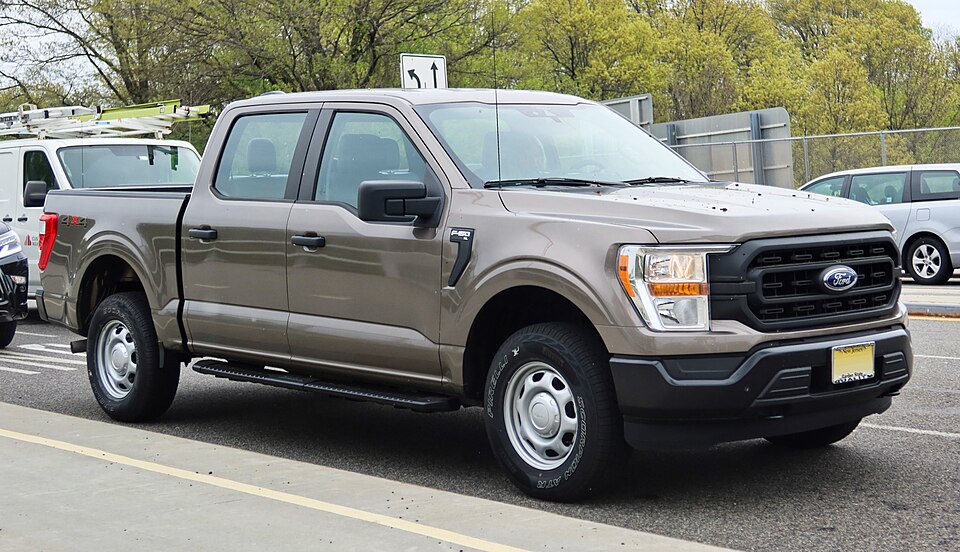
2016 Ford F-150
The 2016 Ford F-150 is sold in the U.S. as a gas large pickup truck with 14 EPA-rated configurations. The most efficient version, the F150 2.7L 2WD GVWR>6649 LBS PAYLOAD PACKAGE, is EPA-rated at 21 mpg combined. NHTSA lists 13 recall campaigns for this model year, 5 rated critical, which gives it a Safety Signal grade of F. Owners have filed 2084 complaints, most often about the power train. NHTSA crash-tested it at 5 stars overall.

Specs & fuel economy
Source: EPA fueleconomy.gov| Configuration | Powertrain | Drive | Engine / motor | City | Hwy | Comb | Annual fuel* |
|---|---|---|---|---|---|---|---|
| F150 2.7L 2WD GVWR>6649 LBS PAYLOAD PACKAGE | Gas | RWD | 2.7L 6-cyl turbo | 18 | 24 | 21 | $3,200 |
| F150 Pickup 2WD | Gas | RWD | 2.7L 6-cyl turbo | 19 | 25 | 21 | $3,200 |
| F150 Pickup 2WD | Gas | RWD | 3.5L 6-cyl turbo | 17 | 24 | 20 | $3,350 |
| F150 Pickup 2WD FFV | Gas | RWD | 3.5L 6-cyl | 18 | 24 | 20 | $3,350 |
| F150 Pickup 4WD | Gas | 4WD (part-time) | 2.7L 6-cyl turbo | 18 | 23 | 20 | $3,350 |
| F150 2.7L 4WD GVWR>6799 LBS PAYLOAD PACKAGE | Gas | 4WD (part-time) | 2.7L 6-cyl turbo | 18 | 22 | 19 | $3,550 |
| F150 Pickup 4WD FFV | Gas | 4WD (part-time) | 3.5L 6-cyl | 17 | 22 | 19 | $3,550 |
| F150 3.5L 2WD GVWR>7599 LBS PAYLOAD PACKAGE | Gas | RWD | 3.5L 6-cyl turbo | 16 | 22 | 18 | $3,700 |
| F150 Pickup 2WD FFV | Gas | RWD | 5.0L 8-cyl | 15 | 22 | 18 | $3,700 |
| F150 Pickup 4WD | Gas | 4WD (part-time) | 3.5L 6-cyl turbo | 16 | 22 | 18 | $3,700 |
| F150 3.5L 4WD GVWR>7599 LBS PAYLOAD PACKAGE | Gas | 4WD (part-time) | 3.5L 6-cyl turbo | 15 | 20 | 17 | $3,950 |
| F150 Pickup 4WD FFV | Gas | 4WD (part-time) | 5.0L 8-cyl | 15 | 21 | 17 | $3,950 |
| F150 5.0L 2WD FFV GVWR>7599 LBS PAYLOAD PACKAGE | Gas | RWD | 5.0L 8-cyl | 14 | 20 | 16 | $4,200 |
| F150 5.0L 4WD FFV GVWR>7599 LBS PAYLOAD PACKAGE | Gas | 4WD (part-time) | 5.0L 8-cyl | 14 | 19 | 16 | $4,200 |
*EPA estimate at 15,000 miles/year at EPA reference fuel and electricity prices. fueleconomy.gov record ids: 37044, 37039, 37040, 37041, 37047, 37051, 37049, 37045, 37042, 37048.
Emissions & certification
Source: EPA emission certificates| Configuration | Smog rating | Emission standard | Where it can be sold new | SmartWay |
|---|---|---|---|---|
| F150 2.7L 2WD GVWR>6649 LBS PAYLOAD PACKAGE, F150 2.7L 4WD GVWR>6799 LBS PAYLOAD PACKAGE, F150 Pickup 2WD, F150 Pickup 4WD | 6–7 / 10 | Bin 4 / LEV-III ULEV70 | All 50 states (federal, all altitudes); California and states following California standards | — |
| F150 3.5L 2WD GVWR>7599 LBS PAYLOAD PACKAGE, F150 3.5L 4WD GVWR>7599 LBS PAYLOAD PACKAGE, F150 Pickup 2WD, F150 Pickup 4WD | 6 / 10 | Bin 4 / LEV-III ULEV125 | All 50 states (federal, all altitudes); California and states following California standards | — |
| F150 5.0L 2WD FFV GVWR>7599 LBS PAYLOAD PACKAGE, F150 5.0L 4WD FFV GVWR>7599 LBS PAYLOAD PACKAGE, F150 Pickup 2WD FFV, F150 Pickup 4WD FFV | 6 / 10 | Bin 4 | All 50 states (federal, all altitudes); California and states following California standards | — |
Certified for all fifty states, so it can be registered new anywhere in the U.S.
The smog rating scores tailpipe pollutants other than greenhouse gases, 1 (worst) to 10 (best), and is comparable only within a model year. The standard is the federal bin or California tier the configuration was certified to. Both come from the EPA certificate behind the window sticker.
Specifications filed with NHTSA
Source: NHTSA vPICDimensions Exterior
| Body style | Pickup |
| GVWR class | Class 2E: 6,001 - 7,000 lb (2,722 - 3,175 kg) |
Engine Basics
| Cylinders | 6 |
| Displacement | 3.5 L |
| Engine configuration | V-Shaped |
Engine Output
| Horsepower | 365 hp |
Fuel Economy
| Fuel | Gasoline |
Transmission
| Drivetrain | 4x2 |
Filed by the manufacturer with NHTSA under the federal vehicle-identification rule and decoded from the VIN pattern — not a manufacturer press kit, so it describes the configurations we could identify rather than every trim. Figures for the trim you are looking at may differ.
Dimensions & weight
Source: Transport Canada| Length | 207.5–248.8 in |
| Width (body, without mirrors) | 79.9 in |
| Height | 75.2–77.2 in |
| Wheelbase | 122.4–163.8 in |
| Track, front | 67.7 in |
| Track, rear | 67.7 in |
| Curb weight | 4,050–4,930 lb |
| Weight distribution, front/rear | 58/42 |
Measured by Transport Canada for its Canadian Vehicle Specifications database, which covers the North American versions of each model — here 12 configurations: P/U Reg Cab 6.5-FT Box 2WD, P/U Reg Cab 6.5-FT Box 4X4, P/U Reg Cab 8-FT Box 2WD, P/U Reg Cab 8-FT Box 4X4, P/U Super Cab 6.5-FT Box 2WD, P/U Super Cab 6.5-FT Box 4X4 …. Where a range is shown, those versions differ. Width is the body without mirrors, which is why it can read narrower than a brochure figure. Before we used it we checked it against the US manufacturer press kits we hold (27 Sep 2026): wheelbase agreed within 1% on every vehicle we could compare, length on 98%, and the curb weight fell inside the manufacturer's range on 96%. Source dataset. Contains information licensed under the Open Government Licence – Canada. Licence.
Factory warranty running out?
The 2016 Ford F-150 is in the years where transmission, electronics and drivetrain repairs land on the owner. What an extended plan does and does not cover is worth reading before a dealer quotes you one.
What to check before you buy →Affiliate disclosure: some links on this page are affiliate links. If you request a quote or buy through them we may earn a commission at no extra cost to you. Nothing on this page changes because of it.
Recalls (13)
Source: NHTSA recall databaseService Brakes, Hydraulic
22S11Service Brakes, Hydraulic
20S31Equipment
20S08Equipment
19S11Engine
18S45Structure
18S27Seats
17S40Latches/Locks/Linkages
17S33Seat Belts
17C12Structure
17C09Seats
16C11Air Bags
16S05These are vehicle campaigns — the ones the automaker filed against this model. NHTSA also records equipment recalls, filed by a parts maker against a component (a tyre, a child seat, an aftermarket part), and those are not listed here or counted above. nhtsa.gov/recalls shows both for a VIN.
NHTSA defect investigations
Power Train:Automatic Transmission:Control Module (Tcm/Pcm/Tecm) — Unintended Transmission Downshift and Rear Wheel Lock-up open
On March 21, 2025, NHTSA’s Office of Defects Investigation (ODI) opened a Preliminary Evaluation (PE25002) to investigate instances of unexpected transmission downshifting without driver input in model year (MY) 2015-2017 Ford F-150 vehicles (subject vehicles) manufactured by Ford Motor Company (Ford). The complaints allege that, without warning or driver input, the subject vehicles experienced a sudden and rapid deceleration often accompanied by temporary rear wheel lockup, seizure, or skidding, resulting in a loss of vehicle control that increases the risk of crash and injury to all motorists, including those not within the subject vehicles. The MY 2015 and MY 2016 F-150 vehicles were equi
Opened Jan 30, 2026 · action EA26001 · the investigation’s page →
Power Train:Automatic Transmission:Control Module (Tcm/Pcm/Tecm) — Unintended Transmission Downshift and Rear Wheel Lock-up closed
On March 21, 2025, NHTSA’s Office of Defects Investigation (ODI) opened this Preliminary Evaluation (PE25002) to investigate instances of unexpected transmission downshifting without driver input in model year (MY) 2015-2017 Ford F-150 vehicles (subject vehicles) manufactured by Ford Motor Company (Ford). The complaints allege that, without warning or driver input, the subject vehicles experienced a sudden and rapid deceleration often accompanied by temporary rear wheel lockup, seizure, or skidding, resulting in a loss of vehicle control that increases the risk of crash and injury to all motorists, including those not within the subject vehicles. The MY 2015 and MY 2016 F-150 vehicles were e
Opened Mar 21, 2025 · closed Jan 30, 2026 · action PE25002 · the investigation’s page →
Seat Belts:Pretensioner — Seatbelt Pretensioner Fire closed
On June 18, 2018, the Office of Defects Investigations (ODI) opened a Preliminary Evaluation (PE18-008) to investigate complaints alleging post-crash fires at the B pillar in the area of the seat belt pretensioners on MY 2014-2018 Ford F-150 Regular Cab, and Super Crew Cab Vehicles. On August 24, 2018, Ford Motor Company recalled (FSA 18S27 - NHTSA #18V568) the affected population. Ford's investigation found that some front seat belt pretensioners may generate sparks during deployment in excess of Ford's specification. Sparks in the pretensioner exhaust gases inside the lower portion of the B-pillar may subsequently ignite combustible components contained in the B-pillar, such as insulation
Opened Aug 3, 2018 · closed Dec 17, 2018 · action PE18008 · the investigation’s page →
Service Brakes, Hydraulic:Foundation Components:Master Cylinder — Brake Master Cylinder Failure closed
On June 8, 2020, Ford Motor Company issued a safety recall (NHTSA Recall No. 20V-332) of 292,311 model year (MY) 2014-2017 Ford F-150 vehicles equipped with 3.5L Ecoboost engines and built from 9/1/2014 to 8/1/2016. Ford stated that the causes of brake fluid loss in the master cylinder are brake fluid contamination that can interfere with rear cup seal function, and rolling of the rearmost cup seal. Prior to total loss of the front brakes, depending on the amount of brake fluid loss in the master cylinder, the driver may receive an audible chime, message center alert and red brake warning indicator in the instrument cluster, and may experience a change in brake pedal travel and increased ped
Opened Sep 28, 2016 · closed Jul 5, 2020 · action RQ16001 · the investigation’s page →
Whether any of this applies to one specific F-150
A campaign covers a build range, not a model year, so two identical-looking cars from 2016 can differ. Both of these check a VIN against the manufacturer’s own list, free, in about ten seconds. Ford publishes its own lookup because federal rule 49 CFR 573.15 requires it to, and to keep it current to within seven days.
Hear about a recall before the letter does
The manufacturer’s letter is the last step of a recall: it has up to 60 days after filing to mail owners, at the address on the registration. We email you the day NHTSA posts a recall on the 2016 Ford F-150, with what to do next. Nothing else, ever — no newsletter, no marketing, one-click unsubscribe in every message.
Parts & accessories for the 2016 Ford F-150
Search by fitment on eBay Motors — OEM take-offs, aftermarket, and the trim pieces dealers no longer stock. The listing and the price are the seller's.
Find parts for this F-150 →Owner complaints
Source: NHTSA complaint database58 involved a crash · 25 a fire · 51 injuries · 0 deaths reported
Filed per year: 2016: 153 · 2017: 152 · 2018: 191 · 2019: 207 · 2020: 155 · 2021: 142 · 2022: 154 · 2023: 186 · 2024: 190 · 2025: 253 · 2026: 301
Most-cited components
In depth: transmission and drivetrain problems → · engine problems → · brake problems → · body and structure problems → · electrical problems →
In owners' own words
Filed with NHTSA by the people who own these cars, one per problem area. Quoted as written, with anything identifying removed.
2016 Ford F-150 xlt 2.7l ecoboost automatic model with approximately 3,400 miles. Had already driven about 4-5 miles with engine already warmed up. Dry weather and about 69 degrees f outside. Came up to stop light with other vehicles ahead slowed down. Came to a complete stop and the auto-stop function engaged and the engine shut off.
Ford throttle body issue - vehicle has less than 9000 miles. While traveling on highway (65-70mph) in a remote area, the vehicle suddenly loss acceleration and begun to shudder. No response when pressing gas pedal. We coasted to the roadside and attempted to restart the car.
I have two windows on my 2016 Ford f 150. Passenger side up and down window moon roof on the passenger side the two above mentioned cracks/stress are with in 18 inches of each other. The passenger up and down window is now cracked from left to right
My 2016 F-150 plarinum with adaptive cruise control, runs up behind vehicles on occasions then brakes hard. If the other vehicle is a semi, as you attempt to pass him with adaptive cruise on, the car brakes hard and slows down on occasions.
Brakes completely fail, when I pushed the brake pedal down. It went straight to the floor with no resistance. This has happened 4 times. Sometimes pumping the brakes helps. The emergency brake was used to stop the vehicle 2 times. Once a sharp swerve off the road while pumping to stop. The last time I coasted to a stop.
Driver door of 2016 Ford F-150 will not latch when closing. Problem primarily occurs after vehicle has been in use. After opening the door, the door will not latch in a secure position when attempting to close. Will occasionally latch when pressing the unlock button after opening.
Complaint counts are raw owner reports to NHTSA, not verified defects, and scale with how many were sold. Use them to spot patterns, not to rank.
Reported by Ford itself: 98 death-or-injury claims on this model year in its quarterly Early Warning reports to NHTSA (49 CFR 579.21): 4 killed, 110 injured, as claimed, not verified. Every F-150 model year, by year and system → Dated and by system, they are exhibit F of the defect dossier.
When owners reported it
miles, typically
Half the 1,126 owner reports with an odometer reading on file fall between 18,000 and 80,000 miles. That is when problems get reported, which is not the same as when they start — and not a failure rate, because nobody knows how many of these cars never had a problem at all.
Median mileage by component
| Component | Reports | Median miles | Vs same age |
|---|---|---|---|
| Service Brakes | 258 | 36,098 | 0.9× |
| Power Train | 234 | 99,800 | 1.92× |
| Engine | 184 | 56,749 | 0.92× |
| Structure | 132 | 20,000 | 0.44× |
| Unspecified | 98 | 28,000 | — |
| Electrical System | 97 | 40,000 | 0.89× |
| Visibility/Wiper | 91 | 48,000 | 1.33× |
| Fuel/Propulsion System | 48 | 47,000 | 1.0× |
Vs same age is this model year’s median for the system divided by the median of every 2016-model-year complaint about the same system, all makes: under 1× means owners of this car reported it at lower mileage. Here, owners reported earlier than same-age vehicles: structure (0.44×); later: power train (1.92×). Which systems go early across the whole fleet: the component study.
Odometer readings as filed by owners with NHTSA. Readings under 100 or over 400,000 miles are dropped as data entry rather than history, and a component needs at least 12 readings before a median is shown for it.
Crash ratings
Source: NHTSA NCAP| Configuration | Overall | Frontal | Side | Rollover | Rollover risk |
|---|---|---|---|---|---|
| PU/CC 4x2 | ★★★★★ | ★★★★★ | ★★★★★ | ★★★★☆ | 19% |
| PU/CC 4x4 | ★★★★★ | ★★★★★ | ★★★★★ | ★★★★☆ | 19% |
| PU/EC 4x2 | ★★★★★ | ★★★★★ | ★★★★★ | ★★★★☆ | 19% |
| PU/EC 4x4 | ★★★★★ | ★★★★★ | ★★★★★ | ★★★★☆ | 19% |
| PU/RC 4x2 | ★★★★★ | ★★★★★ | ★★★★★ | ★★★★☆ | 19% |
| PU/RC 4x4 | ★★★★★ | ★★★★★ | ★★★★★ | ★★★★☆ | 19% |
NHTSA New Car Assessment Program.
Service bulletins & campaigns
Source: NHTSA manufacturer communicationsMost often about: Equipment, Electrical System, Engine, Structure, Power Train.
- 26N04 Other2026-07-09 · Power Train
- Customer Satisfaction Program 26N04 Certain 2015-2017 Model Year F-150 Vehicles Equipped with a 6R80 Transmission Transmission Molded Leadframe Replacement
- 25N17 Other2026-03-25 · Back Over Prevention — Rearview System Braking
- Advance Notice – Customer Satisfaction Program 25N17 Certain 2015-2025 Model Year Multiple Vehicle Lines Rear View Camera Replacement If Required After Dealer Evaluation
- SSM 54601 Service bulletin2026-02-24 · Electrical System
- Ford and Lincoln vehicles equipped with wired keyless entry keypad systems and accessory wireless keyless entry keypad systems may or may not come with a wallet card containing the master code. Unlike the integrated wired keypad, the accessory wireless keypad master code cannot be retrieved from the vehicle using a diagnostic scan tool or from the label printed on the body control module (BCM). Th
- TSB 25-2570 Service bulletin2025-11-26 · Electrical System
- This article supersedes TSB 24-2165 to update the TSB Service Procedure. Some vehicles listed in the Model statement above may exhibit various SYNC performance related concerns including but not limited to: Display operation concerns Navigation inoperative Voice recognition concerns Phone connection issues Dropped phone connections Applink related performance Travel Link not present
- SSM 54366 Service bulletin2025-11-12 · Power Train
- Some 2015-2021 Ford and Lincoln vehicles may exhibit an illuminated MIL with diagnostic trouble codes (DTCs) P0011, P0012, P0014, P0015, P0016, P0017, P0018, P0019, P0021, P0022, P0024 and/or P0025. Pinpoint test HK in the Powertrain Control and Emissions Diagnosis (PC/ED) or in Section 303-14 of the Workshop Manual (WSM) has been updated to address this concern.
- SSM 53495 Service bulletin2025-03-15 · Unknown Or Other
- Some 2016-2020 F-150 vehicles may exhibit an illuminated malfunction indicator lamp (MIL) with diagnostic trouble code (DTC) P0630 stored in the powertrain control module (PCM). This may be due to aftermarket modifications to the body control module (BCM), such as changes to the tire size or axle ratio in the BCM.
- SSM 53174 Service bulletin2024-11-27 · Unknown Or Other
- Various vehicles equipped with a 2.7L or a 3.0L gas engine may require a crankshaft bolt replacement during repairs. Various vehicles equipped with a 2.7L or a 3.0L gas engine may require a crankshaft bolt replacement during repairs.
- SSM 53040 Service bulletin2024-10-10 · Unknown Or Other
- While performing a transmission repair on some 2012-2024 Ford and Lincoln vehicles, a transmission seal kit may be on backorder due to supply chain interruptions.
A service bulletin is the manufacturer telling its dealers how to diagnose or repair a known condition. It is not a recall, not a finding that the vehicle is defective, and the work is not automatically free — though a bulletin is often what a dealer works from when you describe a symptom, so quoting the document number can save a diagnosis. The count is every communication filed; the list shows the most recent, one entry per campaign, because a single campaign is usually filed as several documents on the same day. The summaries are NHTSA's; the full documents come from the manufacturer.
Diagnostic trouble codes on file
Source: NHTSA manufacturer communications and complaintsCodes documented against this model year in the federal record. A code appearing here does not mean this vehicle will set it — it means the code is part of this nameplate-year's documented history.
| Code | What it means | Most often filed under | Where it appears |
|---|---|---|---|
| P0706 | Manufacturer-defined — the meaning is set by the automaker, not the standard. | Power Train | 19 owner reports |
| P0707 | Manufacturer-defined — the meaning is set by the automaker, not the standard. | Power Train | 16 owner reports |
| P0720 | A fault in the output speed sensor circuit. | Power Train | 16 owner reports |
| P2112 P2112 on Ford → | The electronic throttle is stuck closed. | Engine | 15 owner reports |
| P0722 | Manufacturer-defined — the meaning is set by the automaker, not the standard. | Power Train | 12 owner reports |
| P0705 | A fault in the transmission range sensor — the module cannot tell which gear position is selected. | Power Train | 10 owner reports |
| P1702 | Manufacturer-defined — the meaning is set by the automaker, not the standard. | Power Train | 10 owner reports |
| P0715 P0715 on Ford → | A fault in the input or turbine speed sensor circuit. | Power Train | 8 owner reports |
| P0011 P0011 on Ford → | Camshaft timing on bank 1 is more advanced than commanded. | Engine | 7 bulletins |
| P0015 P0015 on Ford → | Manufacturer-defined — the meaning is set by the automaker, not the standard. | Engine | 7 bulletins |
| P0016 P0016 on Ford → | The crankshaft and camshaft are not where they should be relative to each other — timing, chain or phaser. | Engine | 7 bulletins |
| P0017 P0017 on Ford → | Manufacturer-defined — the meaning is set by the automaker, not the standard. | Engine | 7 bulletins |
Generic codes (the second character is 0 or 2) mean the same thing on every vehicle sold in the United States. Manufacturer-specific codes (1 or 3) mean whatever the automaker assigned, and no honest source can define them for you — which is why the ones here carry the evidence instead of a definition. A code is a link when enough separate federal documents name it across the catalogue to be worth a page of its own; the rest are listed here, where the vehicle is the context that makes them mean something.
Affiliate disclosure: some links on this page are affiliate links. If you request a quote or buy through them we may earn a commission at no extra cost to you. Nothing on this page changes because of it.
At the New York inspection station
Source: New York State DMVIn New York’s inspection lanes over the 12 months to Oct 10, 2026, the 2016 Ford F-150 failed the emissions check on 3.9% of first inspections — close to the 4.2% for every 2016 model-year vehicle inspected; and the safety inspection on 1.9% (every 2016 vehicle: 2.2%).
failed emissions
7,428 initial inspections of 7,255 vehicles.
| Measure | The 2016 F-150 | Every 2016 vehicle | Behind it |
|---|---|---|---|
| Failed the emissions check | 3.9% | 4.2% | 7,404 |
| Failed the safety inspection | 1.9% | 2.2% | 7,428 |
| Air-bag warning lamp stayed lit | 0.36% | 0.27% | 7,428 |
| Miles driven a year | 11,272 | 10,028 | odometer at inspection |
| Average odometer | 115,937 | 103,109 | odometer at inspection |
New York’s emissions test on these model years is an on-board diagnostics check: it fails a car whose check-engine light is on or whose self-tests have not finished. First inspections only, so a car that failed and came back is counted once; private and special plates, not taxis, livery or commercial plates. A rate appears only where at least 200 inspections stand behind it. “Every 2016 vehicle” is every 2016 model-year car, SUV and pickup inspected in the same window, all makes. This is the state’s record of test results, not a reliability score by itself. Source: New York State Department of Motor Vehicles, Vehicle Inspections (data.ny.gov, Open NY terms).
F-150 by model year
all years, side by side →Common questions about the 2016 F-150
Source: EPA, NHTSA and manufacturer press kitsDoes the 2016 Ford F-150 have any recalls?
NHTSA has posted 13 recall campaigns for the 2016 Ford F-150, 5 of them rated critical. The most serious on file is 26V237000, covering Power Train. 6 of them were filed with no repair available at the time — NHTSA's file records what the manufacturer had in hand on the filing date, not what exists today. Check your own VIN at nhtsa.gov/recalls; a recall applies to specific build ranges, not every car.
How safe is the 2016 Ford F-150?
NHTSA gave the 2016 Ford F-150 5 stars overall in its New Car Assessment Program tests — 5-star frontal crash, 5-star side crash, 4-star rollover. WhichTrim also grades it F (27/100) on its recall record, which is a different question from crash protection.
What is the fuel economy of the 2016 Ford F-150?
Across the 14 EPA-rated configurations of the 2016 Ford F-150, the best EPA combined figure is 21 mpg. Figures are the EPA's own, per configuration, and every one is listed above.
What are the dimensions of the 2016 Ford F-150?
Transport Canada measured it at 207.5–248.8 in long, 79.9 in wide (body, without mirrors), 75.2–77.2 in tall, on a 122.4–163.8 in wheelbase. Curb weight: 4,050–4,930 lb depending on configuration. Those are its measurements of the North American versions; every figure is in the table above.
What do owners complain about on the 2016 Ford F-150?
Owners have filed 2084 complaints with NHTSA about the 2016 Ford F-150, most often about power train, engine, service brakes. Of those, 58 involved a crash, 25 a fire, 51 reported injuries. Complaints are unverified owner reports, so treat the pattern as a signal and the individual report as an anecdote.
How clean is the 2016 Ford F-150?
The EPA smog rating for the 2016 Ford F-150 runs 6 to 7 out of 10 across its configurations. That score covers tailpipe pollutants other than greenhouse gases, and it only compares vehicles within the same model year. It is certified for all fifty states, so it can be registered new anywhere in the U.S. Its configurations were certified to different standards — Bin 4, LEV-III ULEV125, LEV-III ULEV70 — which the table above lists per configuration.
Are there service bulletins for the 2016 Ford F-150?
The manufacturer has filed 283 service bulletins and related communications with NHTSA for the 2016 Ford F-150, most often covering equipment, electrical system, engine. The most recent is dated 2026-07-09. A bulletin is not a recall: it is the repair procedure a manufacturer sends its dealers for a condition it knows about, and the work is not automatically paid for. It is still worth knowing — if the symptom matches, quoting the bulletin number at the service desk can save a diagnosis. The document numbers and summaries are listed above.
How does the 2016 Ford F-150 do at state inspection?
In New York’s inspection lanes over the 12 months to Oct 10, 2026, the 2016 Ford F-150 failed the emissions check on 3.9% of first inspections — close to the 4.2% for every 2016 model-year vehicle inspected; and the safety inspection on 1.9% (every 2016 vehicle: 2.2%). The figures are New York State DMV’s own inspection records, first inspections only, and the table above sets each one against every vehicle of the same model year.
What we hold, and what an empty row means
Paid vehicle-history reports will not tell you the difference between “nothing happened to this car” and “we never received that record” — both of the big two say as much in their own help pages. Most of what is on this page comes from complete federal registers, so we can tell you which is which, row by row.
| Data | Held | Source | What it covers — or what empty means |
|---|---|---|---|
| Fuel economy & configurations | 14 configurations | EPA certification records | Every configuration the EPA certified for sale, with its own test figures. |
| Emission certificates | 14 configurations | EPA emission certificates | Smog rating, standard and the sales area that decides where the car can be sold new. |
| Recalls | 13 | NHTSA recall campaigns | A complete federal register: every campaign covering this model year, with severity and advisory flags. |
| Owner complaints | 2084 | NHTSA complaint database | Also complete, but unverified: these are reports owners filed, not findings. Counts scale with how many were sold. |
| Crash ratings | 6 tested | NHTSA NCAP | Only the configurations NHTSA chose to crash-test, which is never all of them. |
| Service bulletins | 283 | NHTSA manufacturer communications | Everything the manufacturer told its dealers about a defect or malfunction, short of a recall. |
| Investigations | 4 | NHTSA Office of Defects Investigation | Open and closed defect investigations, with the agency's own narrative. |
| Driver-assist crash reports | none | NHTSA Standing General Order 2021-01 | No report has been filed. Only entities named in the order report, and only crashes they hear of — so this is also what an unequipped car, or a manufacturer without telematics, looks like. |
| Specifications filed with NHTSA | 8 fields | NHTSA vPIC, decoded from VIN patterns | What the manufacturer filed under the federal VIN rule — a configuration, not the full trim ladder. |
| Measured dimensions | 7 fields | Transport Canada, Canadian Vehicle Specifications | Length, width, height, wheelbase, track and curb weight, measured on the North American versions. |
| Trims, pricing & equipment | none | Manufacturer press kit | We have not transcribed a press kit for this model year yet. This is our gap, not the manufacturer's — the one row here where an empty cell means we are behind. |
Rebuilt nightly; this page was generated 2026-10-26. Every figure above is traceable to the source named beside it, and the JSON for this page carries the same values with their identifiers.
Sources & method
Safety Signal starts every model-year at 100 and subtracts points per open NHTSA recall campaign by severity: critical 15 (fire risk, park-outside or do-not-drive advisories), high 8 (brakes, steering, airbags, loss of drive power, structure, battery), moderate 6, minor 3 (software, labels, lighting fixed by an update). The most serious recall counts in full and each further one counts 85% of the one before, because a vehicle sold in millions is recalled more often than a rare one without being more dangerous — and because a flat subtraction bottomed the scale out, scoring a vehicle with 22 recalls within a point of one with six. A ≥ 90, B ≥ 80, C ≥ 70, D ≥ 60, otherwise F. Read it as what it counts: recall campaigns on the federal record, weighted by severity. The damping reduces the sales bias by roughly 40% but does not remove it: like our complaint counts, this is not normalized by how many were sold, so a best-seller still scores somewhat worse than an obscure model with the same real risk. NHTSA crash ratings, do-not-drive and park-outside advisories, and the crash, fire, injury and death counts in owner complaints are reported separately on every page and never blended into the letter — a vehicle can hold five stars and a poor letter at once, and where that happens we say so rather than leave you to notice. Because the scale subtracts from a clean sheet, a model year too new to have been recalled, complained about or bulletined scores full marks on an empty record; we label those grades provisional rather than present them as earned.
EPA figures come from fueleconomy.gov vehicle records. Recalls, complaints, investigations and crash ratings come from NHTSA's public flat files, refreshed nightly.