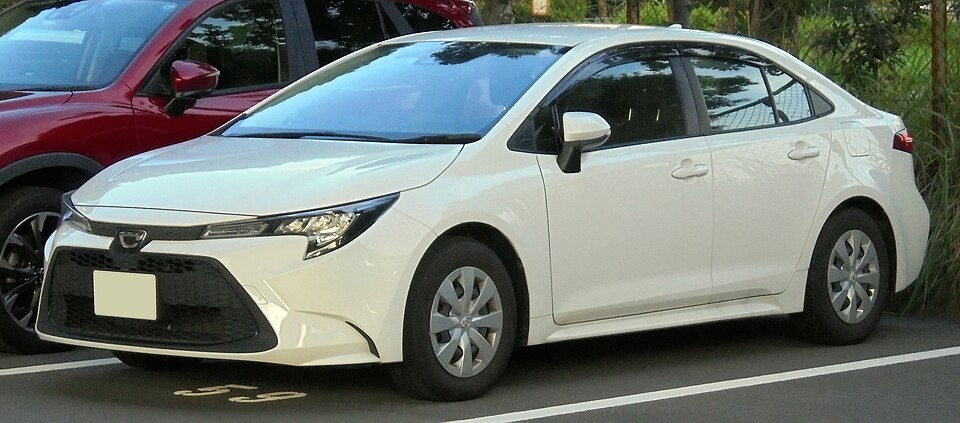
2019 Toyota Corolla
Gas Midsize car
The 2019 Toyota Corolla is sold in the U.S. as a gas midsize car with 8 EPA-rated configurations. The most efficient version, the Corolla Hatchback, is EPA-rated at 36 mpg combined. NHTSA lists 6 recall campaigns for this model year, which gives it a Safety Signal grade of D. Owners have filed 201 complaints, most often about power train. NHTSA crash-tested it at 5 stars overall.
Specs & fuel economy (EPA)
| Configuration | Powertrain | Drive | Engine / motor | City | Hwy | Comb | Annual fuel* |
|---|---|---|---|---|---|---|---|
| Corolla Hatchback | Gas | FWD | 2.0L 4-cyl | 32 | 42 | 36 | $1,750 |
| Corolla LE Eco | Gas | FWD | 1.8L 4-cyl | 30 | 40 | 34 | $1,850 |
| Corolla Hatchback XSE | Gas | FWD | 2.0L 4-cyl | 30 | 38 | 33 | $1,900 |
| Corolla LE Eco | Gas | FWD | 1.8L 4-cyl | 29 | 38 | 33 | $1,900 |
| Corolla | Gas | FWD | 1.8L 4-cyl | 28 | 36 | 32 | $1,950 |
| Corolla | Gas | FWD | 1.8L 4-cyl | 28 | 35 | 31 | $2,000 |
| Corolla Hatchback | Gas | FWD | 2.0L 4-cyl | 28 | 37 | 31 | $2,000 |
| Corolla | Gas | FWD | 1.8L 4-cyl | 27 | 35 | 30 | $2,100 |
*EPA estimate at 15,000 miles/year and EPA reference fuel/electricity prices. Source: fueleconomy.gov vehicle records.
Out of factory warranty soon?
The 2019 Toyota Corolla is in the years where transmission, electronics and drivetrain repairs land on the owner. Compare extended-coverage quotes in about two minutes.
Compare coverage →Affiliate disclosure: some links on this page are affiliate links. If you request a quote or buy through them we may earn a commission at no extra cost to you. Data on this page is never influenced by that.
Recalls (6)
Fuel System, Gasoline
highProblem: Toyota Motor Engineering & Manufacturing (Toyota) is recalling certain 2018-2019 4Runner, 2019-2020 Avalon, 2019 Corolla Hatchback, 2017-2019 Highlander, 2018-2020 Camry, 2020 Corolla, 2018-2019 Land Cruiser, 2017-2020 Tacoma, 2019-2020 RAV4, 2019-2020 Sequoia, 2017-2020 Sienna, 2019-2020 Tundra, 2018-2020 Lexus ES350, 2017 Lexus GS200t, 2017-2019 Lexus GS350, 2019 Lexus GS300, 2018-2020 Lexus LC500h, 2019-2020 Lexus LS500, 2018-2019 Lexus GX460, 2017 Lexus IS200t, 2019 Lexus IS300, 2019 Lexus IS350, 2018-2020 Lexus LC500, 2018 Lexus LS500, 2019 Lexus LS500h, 2018-2019 Lexus LX570, 2017 Lexus RC200t, 2019 Lexus RC300, RC350, 2017 and 2019-2020 Lexus RX350, 2018-2020 RX350L, 2019 Lexus UX200,
Risk: If the fuel pump fails, the engine can stall while driving, increasing the risk of a crash.
Fix: Toyota will notify owners, and dealers will replace the fuel pump assembly with an improved one, free of charge. Owners of specific models were notified that remedy parts were available starting January 21, 2021. Owners of other models will be notified as remedy parts become available. Remedy parts should be available for all affected vehicles by late March 2021. Owners may contact Toyota customer service at 1-888-270-9371 or Lexus customer service at 1-800-255-3987. Note: This recall is an
Air Bags
highProblem: Toyota Motor Engineering & Manufacturing (Toyota) is recalling certain 2011-2019 Corolla, 2011-2013 Matrix, 2012-2018 Avalon, and 2013-2018 Avalon Hybrid vehicles. During certain crashes, the air bag electronic control unit (ECU) may malfunction, possibly disabling the deployment of the air bags and/or seat belt pretensioners.
Risk: In the event of a crash, air bags and/or seat belt pretensioners that do not deploy as intended may increase the risk of injury.
Fix: Toyota will notify owners, and dealers will inspect the ECU and install a noise filter between the air bag control module and its wire harness, as necessary, free of charge. Owners were notified of the safety risk beginning March 2, 2020. A second letter notifying owners of the remedy repair will be mailed between March 16, 2020 and June 27, 2020. Owners may contact Toyota customer service at 1-888-270-9371. Toyota's numbers for this recall are 20TB03, 20TA03 and 20TA05.
Fuel System, Gasoline
highProblem: Toyota Motor Engineering & Manufacturing (Toyota) recalled certain 2018-2019 4Runner, Highlander, Camry, Land Cruiser, Sequoia, Sienna, Tacoma and Tundra, and Lexus RC 300, RC 350, GS 350, GX 460, IS 300, LC 500, LS 500, LX 570, RX 350L, and 2019 Toyota Avalon and Corolla, and certain Lexus NX 300, and ES 350 vehicles on January 13, 2020. On March 4, 2020, Toyota expanded the recall to include certain 2014-2015 Toyota 4Runner and Land Cruiser, 2018 Avalon, Corolla, 2014 FJ Cruiser, 2017 Sienna and Lexus 2018 ES 350, 2018-2019 GS 300, 2013-2014 GS350, 2014-2015 GX 460, IS 350 and LX 570, 2014 IS F, 2018-2019 IS 350, LC 500H and LS 500H, 2013-2015 LS 460, 2015 NX 200T and RC350, 2017 RC 200T
Risk: If the fuel pump fails, the engine can stall while driving, increasing the risk of a crash.
Fix: Toyota will notify owners, and dealers will replace the fuel pump, free of charge. The recall began May 4, 2020. Owners may contact Toyota customer service at 1-888-270-9371 or Lexus customer service at 1-800-255-3987. Toyota's numbers for this recall are 20TB02 and 20TA02 for Toyota vehicles and 20LB01 and 20LA01 for Lexus vehicles.
Equipment
minorProblem: Southeast Toyota Distributors, LLC (SET) is recalling certain 2017-2019 Toyota Camry, Corolla, Rav4, Sienna, and Yaris iA vehicles equipped with factory-installed floor mats. The load carrying capacity modification label may be incorrect. As such, these vehicles fail to comply with the requirements of Federal Motor Vehicle Safety Standard (FMVSS) number 110, "Tire Selection and Rims."
Risk: An incorrect label may lead to unintentionally overloading the vehicle, increasing the risk of a crash.
Fix: SET will notify owners and provide a corrected label for placement over the inaccurate label, free of charge. The recall began August 23, 2019. Owners may contact Toyota customer service at 1-888-270-9371. SET's number for this recall is SET19A.
Equipment
minorProblem: Gulf States Toyota (GST) is recalling certain 2019 C-HR, 4Runner, Avalon, Avalon Hybrid, Camry, Camry Hybrid, Highlander, Land Cruiser, Prius, RAV4, Sequoia, Tacoma, Sienna, Tundra and Yaris vehicles. The text on the load capacity label may become illegible. As such, these vehicles fail to comply with the requirements of Federal Motor Vehicle Safety Standard (FMVSS) number 110, "Tire Selection and Rims."
Risk: If the driver cannot read the label, they may unknowingly overload the vehicle, increasing the risk of a crash.
Fix: GST will notify owners, and dealers will provide corrected load carrying capacity modification labels, free of charge. The recall began May 24, 2019. Owners may contact GST customer service at 1-800-444-1074. GST's number for this recall is 19R1.
Power Train
highProblem: Toyota Motor Engineering & Manufacturing (Toyota) is recalling certain 2019 Toyota Corolla hatchback vehicles equipped with Continuously Variable Transmissions (CVT). The pump impeller blades within the torque converter may detach, especially when driven under high load, potentially causing a vehicle stall.
Risk: A vehicle stall, especially when driving a high rate of speed, can increase the risk of a crash.
Fix: Toyota has notified owners, and dealers will replace the CVT and torque converter, free of charge. The recall began April 22, 2019. Owners may contact Toyota customer service at 1-888-270-9371. Toyota's number for this recall is J17/J07.
NHTSA investigations
Air Bags: Air Bag/Restraint Control Module — Electrical overstress (closed)
The Office of Defects Investigation (ODI) opened this investigation to determine if the failure of airbags to deploy during severe crashes, in certain vehicles, was the result of a safety related defect. During the investigation a complex failure was studied that can result in non-deployment of subject vehicle air bags and other restraint system devices in severe crash events. The subject vehicles may be equipped with an airbag control unit (ACU) for the supplemental restraint system (SRS) Electronic Control Unit (ECU) manufactured by ZF-TRW.  The ECU receives signals from crash sensors mounted in the vehicle and deploys the vehicle air bags and seat belt pretensioners in accordance with
Opened Apr 19, 2019 · closed Sep 19, 2024 · action EA19001
Owner complaints
201 complaints filed
23 involved a crash, 1 a fire, 15 injuries, 1 deaths reported by owners.
Filed by year — 2019: 25 · 2020: 40 · 2021: 13 · 2022: 26 · 2023: 17 · 2024: 38 · 2025: 29 · 2026: 13
Most-cited components
- Power Train — 53
- Engine — 39
- Unknown Or Other — 32
- Air Bags — 31
- Fuel/Propulsion System — 31
Complaint counts are raw owner reports to NHTSA, not verified defects, and scale with how many were sold. Use them to spot patterns, not to rank.
Crash ratings
| Configuration | Overall | Frontal | Side | Rollover | Rollover risk |
|---|---|---|---|---|---|
| 4 DR FWD | ★★★★★ | ★★★★☆ | ★★★★★ | ★★★★☆ | 12% |
| 5 HB FWD | ★★★★★ | ★★★★★ | ★★★★★ | ★★★★☆ | 10% |
NHTSA New Car Assessment Program. Standard driver-assist: forward collision warning, lane departure warning, automatic emergency braking.
Compare the 2019 Corolla with
Other Corolla model years
2027 Corolla
0 recalls · 0 complaints
A2026 Corolla
1 recalls · 15 complaints
B2025 Corolla
2 recalls · 42 complaints
C2024 Corolla
4 recalls · 70 complaints
D2023 Corolla
6 recalls · 84 complaints
A2022 Corolla
0 recalls · 102 complaints
A2021 Corolla
1 recalls · 185 complaints
F2020 Corolla
6 recalls · 307 complaints
B2018 Corolla
3 recalls · 141 complaints
B2017 Corolla
3 recalls · 190 complaints
A2016 Corolla
1 recalls · 213 complaints
Sources & method
Safety Signal starts every model-year at 100 and subtracts points per open NHTSA recall campaign by severity: critical 15 (fire risk, park-outside or do-not-drive advisories), high 8 (brakes, steering, airbags, loss of drive power, structure, battery), moderate 6, minor 3 (software, labels, lighting fixed by an update). Floor 35. A ≥ 90, B ≥ 80, C ≥ 70, D ≥ 60, otherwise F. Complaint counts and NHTSA crash ratings are shown separately and are not blended into the grade.
EPA figures come from fueleconomy.gov vehicle records (ids 40334, 40244, 40335, 40245, 40241, 40242, 40333, 40243). Recalls, complaints, investigations and crash ratings come from NHTSA's public flat files, refreshed weekly.