2019 Hyundai Sonata
The 2019 Hyundai Sonata is sold in the U.S. as a plug-in hybrid, hybrid and gas large sedan with 7 EPA-rated configurations. The most efficient version, the Sonata Hybrid SE, is EPA-rated at 42 mpg combined. NHTSA lists no recall campaigns for this model year so far (Safety Signal A). Owners have filed 172 complaints, most often about the engine. NHTSA crash-tested it at 5 stars overall.
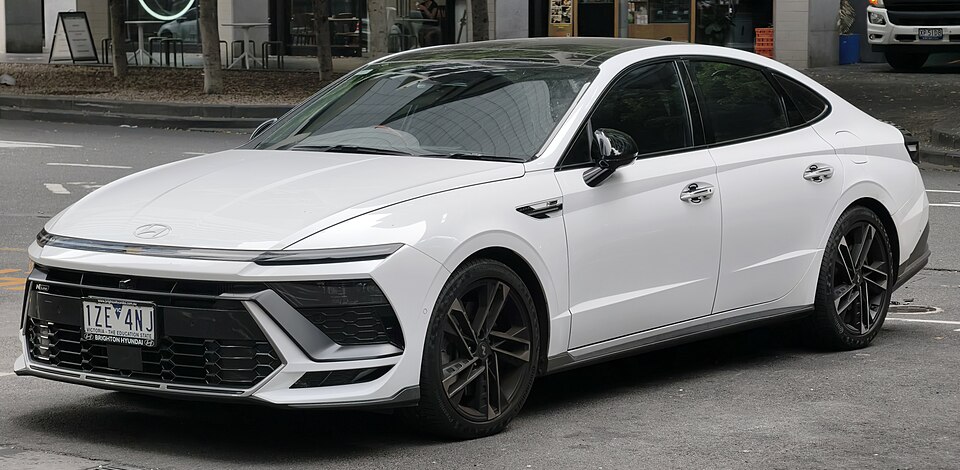
_%E2%80%93_f1_08012026.jpg)
Specs & fuel economy
Source: EPA fueleconomy.gov| Configuration | Powertrain | Drive | Engine / motor | City | Hwy | Comb | Range | kWh/100mi | Charge (240V) | Annual fuel* |
|---|---|---|---|---|---|---|---|---|---|---|
| Sonata Plug-in Hybrid | Plug-in hybrid | FWD | 2.0L 4-cyl + 50 kW IPMSM | 37 | 42 | 39 (59 MPGe blended) | 28 mi electric | 34 | 2.7 h | $1,700 |
| Sonata Hybrid SE | Hybrid | FWD | 2.0L 4-cyl + 270V Li-Ion | 40 | 46 | 42 | — | — | — | $1,600 |
| Sonata Hybrid | Hybrid | FWD | 2.0L 4-cyl + 270V Li-Ion | 39 | 44 | 41 | — | — | — | $1,650 |
| Sonata | Gas | FWD | 1.6L 4-cyl turbo | 28 | 37 | 31 | — | — | — | $2,150 |
| Sonata SE | Gas | FWD | 2.4L 4-cyl | 26 | 35 | 29 | — | — | — | $2,300 |
| Sonata | Gas | FWD | 2.4L 4-cyl | 25 | 33 | 28 | — | — | — | $2,400 |
| Sonata | Gas | FWD | 2.0L 4-cyl turbo | 23 | 32 | 26 | — | — | — | $2,600 |
*EPA estimate at 15,000 miles/year at EPA reference fuel and electricity prices. fueleconomy.gov record ids: 41144, 41050, 41049, 40534, 40532, 40531, 40533.
Emissions & certification
Source: EPA emission certificates| Configuration | Smog rating | Emission standard | Where it can be sold new | SmartWay |
|---|---|---|---|---|
| Sonata Plug-in Hybrid | 7 / 10 | California LEV-III SULEV30 / Federal Tier 3 Bin 30 | All 50 states (federal, all altitudes); California and states following California standards | SmartWay Elite |
| Sonata Hybrid, Sonata Hybrid SE | 7 / 10 | California LEV-III SULEV30 / Federal Tier 3 Bin 30 | All 50 states (federal, all altitudes); California and states following California standards | SmartWay |
| Sonata | 5 / 10 | California LEV-III ULEV70 / Federal Tier 3 Bin 70 | All 50 states (federal, all altitudes); California and states following California standards | SmartWay |
| Sonata, Sonata SE | 7 / 10 | California LEV-III SULEV30 / Federal Tier 3 Bin 30 | All 50 states (federal, all altitudes); California and states following California standards | — |
| Sonata | 5 / 10 | California LEV-III ULEV70 / Federal Tier 3 Bin 70 | All 50 states (federal, all altitudes); California and states following California standards | — |
Certified for all fifty states, so it can be registered new anywhere in the U.S.
The smog rating scores tailpipe pollutants other than greenhouse gases, 1 (worst) to 10 (best), and is comparable only within a model year. The standard is the federal bin or California tier the configuration was certified to. Both come from the EPA certificate behind the window sticker.
Specifications filed with NHTSA
Source: NHTSA vPICDimensions Exterior
| Body style | Sedan/Saloon |
| Doors | 4 |
| GVWR class | Class 1: 6,000 lb or less (2,722 kg or less) |
Engine Basics
| Cylinders | 4 |
| Displacement | 2.4 L |
Engine Output
| Horsepower | 187 hp |
Fuel Economy
| Fuel | Gasoline |
Seating
| Seat rows | 2 |
| Seating capacity | 5 seats |
Transmission
| Drivetrain | FWD/Front-Wheel Drive |
Driver assistance
Standard: Adaptive cruise control, Anti-lock brakes, Backup camera, Blind-spot monitoring, Electronic stability control, Pedestrian automatic emergency braking
Optional: Lane keeping assist, Parking assist
Filed by the manufacturer with NHTSA under the federal vehicle-identification rule and decoded from the VIN pattern — not a manufacturer press kit, so it describes the configurations we could identify rather than every trim (seen: Eco Turbo, SE, Hybrid Limited, Hybrid SE, Plug-In Hybrid). Figures for the trim you are looking at may differ.
Dimensions & weight
Source: Transport Canada| Length | 191.3 in |
| Width (body, without mirrors) | 73.6 in |
| Height | 58.3 in |
| Wheelbase | 110.6 in |
| Track, front | 63.0–63.4 in |
| Track, rear | 63.0–63.8 in |
| Curb weight | 3,252–3,814 lb |
| Weight distribution, front/rear | 59/41 to 61/39 |
Measured by Transport Canada for its Canadian Vehicle Specifications database, which covers the North American versions of each model — here 6 configurations: 4-door Sedan 2.0L, 4-door Sedan Essential, 4-door Sedan Hybrid Gl, 4-door Sedan Hybrid Gls/Limited, 4-door Sedan PHEV, 4-door Sedan Sport/Preferred/Luxury. Where a range is shown, those versions differ. Width is the body without mirrors, which is why it can read narrower than a brochure figure. Before we used it we checked it against the US manufacturer press kits we hold (27 Sep 2026): wheelbase agreed within 1% on every vehicle we could compare, length on 98%, and the curb weight fell inside the manufacturer's range on 96%. Source dataset. Contains information licensed under the Open Government Licence – Canada. Licence.
Factory warranty running out?
The 2019 Hyundai Sonata is in the years where high-voltage electronics and module repairs land on the owner. What an extended plan does and does not cover is worth reading before a dealer quotes you one.
What to check before you buy →Affiliate disclosure: some links on this page are affiliate links. If you request a quote or buy through them we may earn a commission at no extra cost to you. Nothing on this page changes because of it.
Recalls (0)
Source: NHTSA recall databaseNo NHTSA recall campaigns are on file for the 2019 Hyundai Sonata. New campaigns appear here within a week of NHTSA posting them.
These are vehicle campaigns — the ones the automaker filed against this model. NHTSA also records equipment recalls, filed by a parts maker against a component (a tyre, a child seat, an aftermarket part), and those are not listed here or counted above. nhtsa.gov/recalls shows both for a VIN.
NHTSA defect investigations
Electrical System:Propulsion System — Pedestrian alert sounds closed
NHTSA received a petition on or about July 18, 2022, requesting that Federal Motor Vehicle Safety Standard (FMVSS) 141 be applied to all electric and hybrid vehicles operating in the United States. The petition can be reviewed at NHTSA.gov under ODI Number 11486072. FMVSS 141 establishes performance requirements for pedestrian alert sounds for motor vehicles. The standard applies to hybrid and electric vehicles that have a gross vehicle weight rating of 4,536 KG or less or are defined as low-speed vehicles. The standard became fully applicable to all such vehicles manufactured on or after March 1, 2021. On January 27, 2023, NHTSA opened Defect Petition (DP) 22-005 to evaluate the subject mat
Opened Jan 27, 2023 · closed Aug 7, 2023 · action DP22005 · the investigation’s page →
Engine — Loss of Motive Power closed
The National Highway Traffic Safety Administration (NHTSA) received a letter dated July 13, 2022, petitioning the Agency to initiate a safety defect investigation into loss of motive power allegations attributed to oil drain pan assembly failures on certain Hyundai Motor America, Inc. and Kia America, Inc. vehicles spanning Model Years (MY) 2005-2021. The Petitioners cited examples of complaints indicating that the subject vehicles were experiencing rapid loss of engine oil due to oil drain plug back outs, resulting in loss of motive power and/or catastrophic engine damage. Additional complaints were provided which alleged that the oil drain pans lack sufficient structural integrity and are
Opened Sep 12, 2022 · closed Dec 12, 2023 · action DP22003 · the investigation’s page →
Air Bags: Air Bag/Restraint Control Module — Electrical overstress closed
The Office of Defects Investigation (ODI) opened this investigation to determine if the failure of airbags to deploy during severe crashes, in certain vehicles, was the result of a safety related defect. During the investigation a complex failure was studied that can result in non-deployment of subject vehicle air bags and other restraint system devices in severe crash events. The subject vehicles may be equipped with an airbag control unit (ACU) for the supplemental restraint system (SRS) Electronic Control Unit (ECU) manufactured by ZF-TRW. The ECU receives signals from crash sensors mounted in the vehicle and deploys the vehicle air bags and seat belt pretensioners in accordance with ma
Opened Apr 19, 2019 · closed Sep 19, 2024 · action EA19001 · the investigation’s page →
Hear about a recall before the letter does
The manufacturer’s letter is the last step of a recall: it has up to 60 days after filing to mail owners, at the address on the registration. We email you the day NHTSA posts a recall on the 2019 Hyundai Sonata, with what to do next. Nothing else, ever — no newsletter, no marketing, one-click unsubscribe in every message.
Parts & accessories for the 2019 Hyundai Sonata
Search by fitment on eBay Motors — OEM take-offs, aftermarket, and the trim pieces dealers no longer stock. The listing and the price are the seller's.
Find parts for this Sonata →Owner complaints
Source: NHTSA complaint database9 involved a crash · 6 a fire · 7 injuries · 0 deaths reported
18 per 10,000 built · Hyundai reported 93,241 Sonata built (its Early Warning production report to NHTSA)
Filed per year: 2019: 13 · 2020: 14 · 2021: 3 · 2022: 12 · 2023: 24 · 2024: 39 · 2025: 35 · 2026: 32
Most-cited components
In depth: engine problems →
In owners' own words
Filed with NHTSA by the people who own these cars, one per problem area. Quoted as written, with anything identifying removed.
The high voltage battery will no longer charge neither from being plugged in to the charger on the wall nor from the buikt in system onboard the car. There are warning lights saying the inverter coolant is low but the reservoir is at the proper level.
The primary failure is in the Engine/Powertrain system and Knock Sensor Detection System (KSDS), causing 6 identical sudden engine stalls (OBD-II code P1326) from 09/2000 to 06/2026. Additionally, severe excessive oil consumption was documented during 2 of these diagnostic visits, showing deep-seated engine issues.
am writing regarding 43099808 Number with Hyundai My 2019 Sonata hybird se in limp mode with an active flashing P1326 knock sensor code. The dealership is using an automated system denial to try and charge me $2,110 for an EGR valve and air filter. I am officially challenging this diagnostic path.
While driving the car it suddenly decelerated and multiple warning errors on electronics, driver assist, braking started going off then the error message of Check Hybrid Turn Engine Off came on. I was able to coast into a parking lot as the car could only go around 5 miles an hour.
The contact owns a 2019 Hyundai Sonata. The contact stated that while driving approximately 78 mph, a second vehicle crashed into the front passenger side causing the driver to lose control of the vehicle and crash into a concrete median.
Just purchased this vehicle yesterday 8/10/2021. Drove it home at night. there were significant blindspots, and a shadow in the headlight beam. Headlights only illuminated the bottom half of the of the beam hemispheres.
Complaint counts are raw owner reports to NHTSA, not verified defects, and scale with how many were sold. Use them to spot patterns, not to rank.
Reported by Hyundai itself: 15 death-or-injury claims on this model year in its quarterly Early Warning reports to NHTSA (49 CFR 579.21): 2 killed, 16 injured, as claimed, not verified — about 16 per 100,000 built. Every Sonata model year, by year and system → Dated and by system, they are exhibit F of the defect dossier.
When owners reported it
miles, typically
Half the 45 owner reports with an odometer reading on file fall between 5,000 and 89,000 miles. That is when problems get reported, which is not the same as when they start — and not a failure rate, because nobody knows how many of these cars never had a problem at all.
Median mileage by component
| Component | Reports | Median miles | Vs same age |
|---|---|---|---|
| Engine | 22 | 89,000 | 2.12× |
| Exterior Lighting | 12 | 4,900 | 0.41× |
Vs same age is this model year’s median for the system divided by the median of every 2019-model-year complaint about the same system, all makes: under 1× means owners of this car reported it at lower mileage. Here, owners reported earlier than same-age vehicles: exterior lighting (0.41×); later: engine (2.12×). Which systems go early across the whole fleet: the component study.
Across 2018–2020 model years the Hyundai Sonata ranks 31 of 79 nameplates in the odometer-at-first-complaint study: owners reported problems at 0.78× the mileage of vehicles the same age (median 20,000 miles against a fleet 23,512).
Odometer readings as filed by owners with NHTSA. Readings under 100 or over 400,000 miles are dropped as data entry rather than history, and a component needs at least 12 readings before a median is shown for it.
Crash ratings
Source: NHTSA NCAP| Configuration | Overall | Frontal | Side | Rollover | Rollover risk |
|---|---|---|---|---|---|
| 4 DR FWD | ★★★★★ | ★★★★★ | ★★★★★ | ★★★★☆ | 10% |
| 4 DR FWD | ★★★★★ | ★★★★★ | ★★★★★ | ★★★★☆ | 10% |
NHTSA New Car Assessment Program.
Service bulletins & campaigns
Source: NHTSA manufacturer communications- 3 years or 36,000 miles · Hyundai warranty extension Z05Certain 2015 – 2018 model year Elantra, 2015 – 2019 model year Sonata, 2017 – 2021 model year Tucson, 2017 – 2018 model year Santa Fe Sport, 2019 model year Santa Fe, 2021 – 2023 model year Santa Fe…
- Term not in NHTSA’s summary · Hyundai warranty extension T6G TXXMThis TSB references the Op codes to use for claim submission and the Parts required based on the vehicle’s inspection results from TSB 22-01-023H (DTC P1326 – Engine Bearing Inspection/Engine…
- Term not in NHTSA’s summary · Hyundai warranty extension T6GThis TSB references the Op codes to use for claim submission and the Parts required based on the vehicle’s inspection results from TSB 22-01-023H-2 (DTC P1326 – Engine Bearing Inspection/Engine…
- 15 years or 150,000 miles, whichever comes first · Hyundai bulletin 23-FL-004HCertain 2015-2019MY Sonata (LFA) vehicles may intermittently exhibit reduced engine power, a “Crank/No Start” condition, and/or have DTC P1233 stored in the ECM due to an internally leaking fuel pump…
The term and the vehicles it covers are the manufacturer’s, as NHTSA’s summary of each filing states them; a dealer checks one particular car by its VIN. Every Hyundai warranty extension (62) → · Every warranty extension on file, all makes →
Most often about: Engine, Electrical System, Equipment, Steering, Power Train.
- 26-EM-016H TSB Service bulletin2026-10-08 · Engine
- Some vehicles equipped with internal combustion engines may exhibit higher-than-expected engine oil consumption. This bulletin outlines the combustion chamber cleaning procedure for vehicles diagnosed with this condition. All internal combustion engines consume some engine oil during normal operation, depending on driving conditions and mileage, and this procedure should only be performed when dee
- 26-EM-015H TSB Service bulletin2026-10-07 · Engine
- Certain vehicles equipped with internal combustion engines may exhibit higher-than-expected engine oil consumption. This bulletin provides the inspection and repair procedures for vehicles exhibiting this condition. All internal combustion engines consume engine oil as part of normal engine operation. Oil consumption rates may vary based on mileage, operating conditions, driving habits, and mainte
- Z05 OL Warranty extension2026-08-26 · Unknown Or Other
- Certain vehicles may exhibit excessive paint peeling or bubbling of the primer/paint film on the exterior metal body panels: hood, fender(s), roof, door(s), quarter panel(s), and tailgate/trunk. This warranty extension only applies to factory-applied paint and does not cover collision-related paint repairs or vehicles with a salvaged title. Hyundai is extending the warranty coverage for certain wh
- 26-01-013H-2 DN Service campaign2026-05-21 · Electrical System
- Certain Santa Fe (TMA), Santa Fe Sport (AN), Sonata (LFA), and Tucson (TL) vehicles equipped with Theta II engines may exhibit elevated engine-out emissions. The California Air Resources Board has determined that these vehicles may be releasing air pollutants which exceed Federal and California standards.
- 26-EE-003H TSB Service bulletin2026-04-18 · Electrical System
- Some vehicles may exhibit difficulty starting in cold weather. This bulletin provides the procedure to perform an inspection on the starter magnetic switch for potential freezing and, if necessary, replace the starter magnetic switch (solenoid) assembly.
- 11032523 Other2026-04-10 · Air Bags
- The National Highway Traffic Safety Administration (NHTSA) has identified the presence of substandard and dangerous driver’s-side airbag inflators manufactured by Jilin Province Detiannuo Automobile Safety System Co., Ltd. (DTN). These inflators were not supplied, approved, or authorized by the vehicle manufacturers and have primarily been found in vehicles that previously experienced a crash and
- 11032522 Other2026-04-10 · Air Bags
- The National Highway Traffic Safety Administration (NHTSA) has issued an urgent safety advisory regarding dangerous, counterfeit driver‑side airbag inflators manufactured by Jilin Province Detiannuo Automobile Safety System Co., Ltd. (DTN), that have been identified in U.S. vehicles following prior crashes, theft, or non‑certified airbag replacements. These inflators are not approved for use, may
- 26-01-033H TSB Warranty extension2026-03-26 · Engine
- This TSB references the Op codes to use for claim submission and the Parts required based on the vehicle’s inspection results from TSB 22-01-023H-2 (DTC P1326 – Engine Bearing Inspection/Engine Replacement) or the latest version.
A service bulletin is the manufacturer telling its dealers how to diagnose or repair a known condition. It is not a recall, not a finding that the vehicle is defective, and the work is not automatically free — though a bulletin is often what a dealer works from when you describe a symptom, so quoting the document number can save a diagnosis. The count is every communication filed; the list shows the most recent, one entry per campaign, because a single campaign is usually filed as several documents on the same day. The summaries are NHTSA's; the full documents come from the manufacturer.
Diagnostic trouble codes on file
Source: NHTSA manufacturer communications and complaintsCodes documented against this model year in the federal record. A code appearing here does not mean this vehicle will set it — it means the code is part of this nameplate-year's documented history.
| Code | What it means | Most often filed under | Where it appears |
|---|---|---|---|
| P1326 P1326 on Hyundai → | Manufacturer-defined — the meaning is set by the automaker, not the standard. | Engine | 28 bulletins · 3 owner reports |
| C120B | Manufacturer-defined — the meaning is set by the automaker, not the standard. | Lane Departure | 3 bulletins |
| C160A | Manufacturer-defined — the meaning is set by the automaker, not the standard. | Lane Departure | 3 bulletins |
| P0705 P0705 on Hyundai → | A fault in the transmission range sensor — the module cannot tell which gear position is selected. | Electrical System · Battery → | 3 bulletins |
| P0706 P0706 on Hyundai → | Manufacturer-defined — the meaning is set by the automaker, not the standard. | Electrical System · Battery → | 3 bulletins |
| P0707 P0707 on Hyundai → | Manufacturer-defined — the meaning is set by the automaker, not the standard. | Electrical System · Battery → | 3 bulletins |
| P0708 | Manufacturer-defined — the meaning is set by the automaker, not the standard. | Electrical System · Battery → | 3 bulletins |
| P0880 P0880 on Hyundai → | Manufacturer-defined — the meaning is set by the automaker, not the standard. | Power Train | 3 bulletins |
| P0456 P0456 on Hyundai → | A very small leak in the evaporative emissions system. | Engine · Gas cap → | 2 bulletins |
| P050A | Manufacturer-defined — the meaning is set by the automaker, not the standard. | Engine | 2 bulletins |
| P1233 P1233 on Hyundai → | Manufacturer-defined — the meaning is set by the automaker, not the standard. | Engine | 2 bulletins |
| P2600 | Manufacturer-defined — the meaning is set by the automaker, not the standard. | Engine | 2 bulletins |
Generic codes (the second character is 0 or 2) mean the same thing on every vehicle sold in the United States. Manufacturer-specific codes (1 or 3) mean whatever the automaker assigned, and no honest source can define them for you — which is why the ones here carry the evidence instead of a definition. A code is a link when enough separate federal documents name it across the catalogue to be worth a page of its own; the rest are listed here, where the vehicle is the context that makes them mean something.
Affiliate disclosure: some links on this page are affiliate links. If you request a quote or buy through them we may earn a commission at no extra cost to you. Nothing on this page changes because of it.
At the New York inspection station
Source: New York State DMVIn New York’s inspection lanes over the 12 months to Oct 10, 2026, the 2019 Hyundai Sonata failed the emissions check on 2.6% of first inspections — close to the 2.7% for every 2019 model-year vehicle inspected; and the safety inspection on 2.0% (every 2019 vehicle: 1.7%).
failed emissions
3,520 initial inspections of 3,443 vehicles.
| Measure | The 2019 Sonata | Every 2019 vehicle | Behind it |
|---|---|---|---|
| Failed the emissions check | 2.6% | 2.7% | 3,511 |
| Failed the safety inspection | 2.0% | 1.7% | 3,520 |
| Air-bag warning lamp stayed lit | 0.20% | 0.20% | 3,520 |
| Miles driven a year | 8,546 | 9,904 | odometer at inspection |
| Average odometer | 62,072 | 72,084 | odometer at inspection |
New York’s emissions test on these model years is an on-board diagnostics check: it fails a car whose check-engine light is on or whose self-tests have not finished. First inspections only, so a car that failed and came back is counted once; private and special plates, not taxis, livery or commercial plates. A rate appears only where at least 200 inspections stand behind it. “Every 2019 vehicle” is every 2019 model-year car, SUV and pickup inspected in the same window, all makes. This is the state’s record of test results, not a reliability score by itself. Source: New York State Department of Motor Vehicles, Vehicle Inspections (data.ny.gov, Open NY terms).
Sonata by model year
all years, side by side →Common questions about the 2019 Sonata
Source: EPA, NHTSA and manufacturer press kitsDoes the 2019 Hyundai Sonata have any recalls?
No NHTSA recall campaigns are on file for the 2019 Hyundai Sonata. New campaigns appear here within a week of NHTSA posting them, and a clean sheet on a recent model year often just means the vehicle is new.
How safe is the 2019 Hyundai Sonata?
NHTSA gave the 2019 Hyundai Sonata 5 stars overall in its New Car Assessment Program tests — 5-star frontal crash, 5-star side crash, 4-star rollover. WhichTrim also grades it A (100/100) on its recall record, which is a different question from crash protection.
What is the fuel economy of the 2019 Hyundai Sonata?
Across the 7 EPA-rated configurations of the 2019 Hyundai Sonata, the best EPA combined figure is 42 mpg (MPGe on the electrified versions). Figures are the EPA's own, per configuration, and every one is listed above.
What are the dimensions of the 2019 Hyundai Sonata?
Transport Canada measured it at 191.3 in long, 73.6 in wide (body, without mirrors), 58.3 in tall, on a 110.6 in wheelbase. Curb weight: 3,252–3,814 lb depending on configuration. Those are its measurements of the North American versions; every figure is in the table above.
What do owners complain about on the 2019 Hyundai Sonata?
Owners have filed 172 complaints with NHTSA about the 2019 Hyundai Sonata, most often about engine, unspecified, exterior lighting. Of those, 9 involved a crash, 6 a fire, 7 reported injuries. Complaints are unverified owner reports, so treat the pattern as a signal and the individual report as an anecdote.
How clean is the 2019 Hyundai Sonata?
The EPA smog rating for the 2019 Hyundai Sonata runs 5 to 7 out of 10 across its configurations. That score covers tailpipe pollutants other than greenhouse gases, and it only compares vehicles within the same model year. It is certified for all fifty states, so it can be registered new anywhere in the U.S. Its configurations were certified to different standards — California LEV-III SULEV30, California LEV-III ULEV70, Federal Tier 3 Bin 30, Federal Tier 3 Bin 70 — which the table above lists per configuration.
Are there service bulletins for the 2019 Hyundai Sonata?
The manufacturer has filed 317 service bulletins and related communications with NHTSA for the 2019 Hyundai Sonata, most often covering engine, electrical system, equipment. The most recent is dated 2026-10-08. A bulletin is not a recall: it is the repair procedure a manufacturer sends its dealers for a condition it knows about, and the work is not automatically paid for. It is still worth knowing — if the symptom matches, quoting the bulletin number at the service desk can save a diagnosis. The document numbers and summaries are listed above.
How does the 2019 Hyundai Sonata do at state inspection?
In New York’s inspection lanes over the 12 months to Oct 10, 2026, the 2019 Hyundai Sonata failed the emissions check on 2.6% of first inspections — close to the 2.7% for every 2019 model-year vehicle inspected; and the safety inspection on 2.0% (every 2019 vehicle: 1.7%). The figures are New York State DMV’s own inspection records, first inspections only, and the table above sets each one against every vehicle of the same model year.
What we hold, and what an empty row means
Paid vehicle-history reports will not tell you the difference between “nothing happened to this car” and “we never received that record” — both of the big two say as much in their own help pages. Most of what is on this page comes from complete federal registers, so we can tell you which is which, row by row.
| Data | Held | Source | What it covers — or what empty means |
|---|---|---|---|
| Fuel economy & configurations | 7 configurations | EPA certification records | Every configuration the EPA certified for sale, with its own test figures. |
| Emission certificates | 7 configurations | EPA emission certificates | Smog rating, standard and the sales area that decides where the car can be sold new. |
| Recalls | none | NHTSA recall campaigns | No campaign has been filed. Because the register is complete, an empty row here means there is nothing to find — not that we are missing it. |
| Owner complaints | 172 | NHTSA complaint database | Also complete, but unverified: these are reports owners filed, not findings. Counts scale with how many were sold. |
| Crash ratings | 2 tested | NHTSA NCAP | Only the configurations NHTSA chose to crash-test, which is never all of them. |
| Service bulletins | 317 | NHTSA manufacturer communications | Everything the manufacturer told its dealers about a defect or malfunction, short of a recall. |
| Investigations | 3 | NHTSA Office of Defects Investigation | Open and closed defect investigations, with the agency's own narrative. |
| Driver-assist crash reports | none | NHTSA Standing General Order 2021-01 | No report has been filed. Only entities named in the order report, and only crashes they hear of — so this is also what an unequipped car, or a manufacturer without telematics, looks like. |
| Specifications filed with NHTSA | 10 fields | NHTSA vPIC, decoded from VIN patterns | What the manufacturer filed under the federal VIN rule — a configuration, not the full trim ladder. |
| Measured dimensions | 7 fields | Transport Canada, Canadian Vehicle Specifications | Length, width, height, wheelbase, track and curb weight, measured on the North American versions. |
| Trims, pricing & equipment | none | Manufacturer press kit | We have not transcribed a press kit for this model year yet. This is our gap, not the manufacturer's — the one row here where an empty cell means we are behind. |
Rebuilt nightly; this page was generated 2026-10-26. Every figure above is traceable to the source named beside it, and the JSON for this page carries the same values with their identifiers.
Sources & method
Safety Signal starts every model-year at 100 and subtracts points per open NHTSA recall campaign by severity: critical 15 (fire risk, park-outside or do-not-drive advisories), high 8 (brakes, steering, airbags, loss of drive power, structure, battery), moderate 6, minor 3 (software, labels, lighting fixed by an update). The most serious recall counts in full and each further one counts 85% of the one before, because a vehicle sold in millions is recalled more often than a rare one without being more dangerous — and because a flat subtraction bottomed the scale out, scoring a vehicle with 22 recalls within a point of one with six. A ≥ 90, B ≥ 80, C ≥ 70, D ≥ 60, otherwise F. Read it as what it counts: recall campaigns on the federal record, weighted by severity. The damping reduces the sales bias by roughly 40% but does not remove it: like our complaint counts, this is not normalized by how many were sold, so a best-seller still scores somewhat worse than an obscure model with the same real risk. NHTSA crash ratings, do-not-drive and park-outside advisories, and the crash, fire, injury and death counts in owner complaints are reported separately on every page and never blended into the letter — a vehicle can hold five stars and a poor letter at once, and where that happens we say so rather than leave you to notice. Because the scale subtracts from a clean sheet, a model year too new to have been recalled, complained about or bulletined scores full marks on an empty record; we label those grades provisional rather than present them as earned.
EPA figures come from fueleconomy.gov vehicle records. Recalls, complaints, investigations and crash ratings come from NHTSA's public flat files, refreshed nightly.