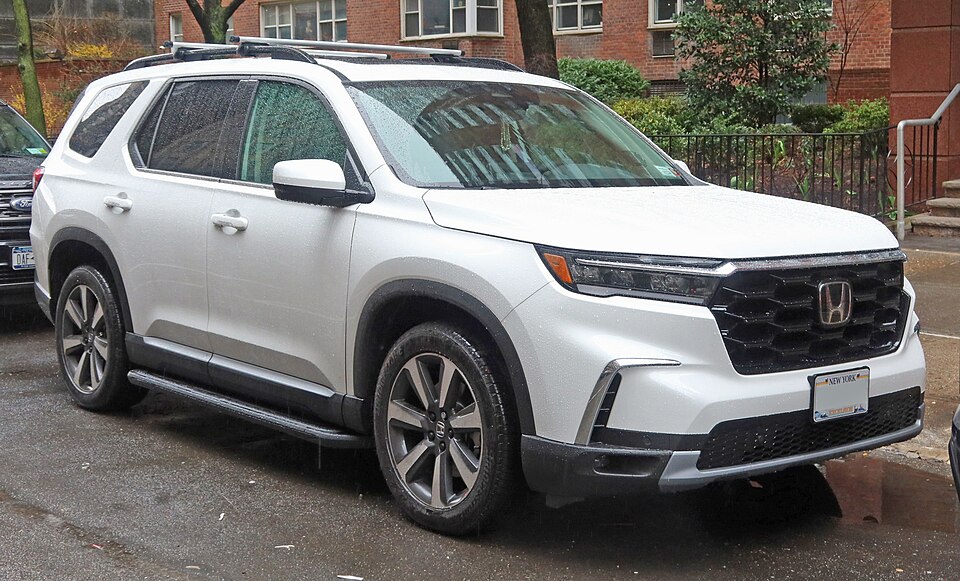
2026 Honda Pilot
The 2026 Honda Pilot is sold in the U.S. as a gas large SUV with 4 EPA-rated configurations. The most efficient version, the Pilot FWD, is EPA-rated at 22 mpg combined. NHTSA lists 1 recall campaign for this model year, which gives it a Safety Signal grade of A. Owners have filed 27 complaints, most often about the steering. NHTSA crash-tested it at 5 stars overall. Manufacturer pricing runs from $42,395 to $55,195 across 8 trims.

| Trim | Powertrain | Drive | MSRP | HP | Torque | MPG comb | Seats | Cargo (2nd row) | Wheels |
|---|---|---|---|---|---|---|---|---|---|
| Sport | Gas | FWD | $42,395 | 285 hp | 262 lb-ft | 22 mpg | 8 | 48.5 cu-ft | 20 in |
| Sport | Gas | AWD | $44,495 | 285 hp | 262 lb-ft | 21 mpg | 8 | 48.5 cu-ft | 20 in |
| EX-L | Gas | FWD | $44,695 | 285 hp | 262 lb-ft | 22 mpg | 8 | 48.5 cu-ft | 18 in |
| EX-L | Gas | AWD | $46,795 | 285 hp | 262 lb-ft | 21 mpg | 8 | 48.5 cu-ft | 18 in |
| TrailSport | Gas | AWD | $50,595 | 285 hp | 262 lb-ft | 20 mpg | 7 | 48.5 cu-ft | 18 in |
| Touring | Gas | AWD | $51,295 | 285 hp | 262 lb-ft | 21 mpg | 8 | 48.5 cu-ft | 20 in |
| Elite | Gas | AWD | $53,695 | 285 hp | 262 lb-ft | 21 mpg | 8 | 48.5 cu-ft | 20 in |
| Black Edition | Gas | AWD | $55,195 | 285 hp | 262 lb-ft | 21 mpg | 8 | 48.5 cu-ft | 20 in |
MSRP excludes destination. Open a trim for the complete spec sheet and standard/optional equipment. Have the car in front of you? Decode its VIN to see which of these trims it is and what it was priced at.
Specs & fuel economy
Source: EPA fueleconomy.gov| Configuration | Powertrain | Drive | Engine / motor | City | Hwy | Comb | Annual fuel* |
|---|---|---|---|---|---|---|---|
| Pilot FWD | Gas | FWD | 3.5L 6-cyl | 19 | 27 | 22 | $3,050 |
| Pilot AWD | Gas | AWD | 3.5L 6-cyl | 19 | 25 | 21 | $3,200 |
| Pilot AWD Touring/Elite/Black | Gas | AWD | 3.5L 6-cyl | 19 | 25 | 21 | $3,200 |
| Pilot AWD TrailSport | Gas | AWD | 3.5L 6-cyl | 18 | 23 | 20 | $3,350 |
*EPA estimate at 15,000 miles/year at EPA reference fuel and electricity prices. fueleconomy.gov record ids: 50113, 50154, 50155, 50156.
The cheapest ownership win
Insurers price the 2026 Pilot very differently, and the gap between the best and worst quote on the same car and driver is usually larger than any option you are weighing on this page.
How to compare cover →Affiliate disclosure: some links on this page are affiliate links. If you request a quote or buy through them we may earn a commission at no extra cost to you. Nothing on this page changes because of it.
Recalls (1)
Source: NHTSA recall databaseThese are vehicle campaigns — the ones the automaker filed against this model. NHTSA also records equipment recalls, filed by a parts maker against a component (a tyre, a child seat, an aftermarket part), and those are not listed here or counted above. nhtsa.gov/recalls shows both for a VIN.
Whether any of this applies to one specific Pilot
A campaign covers a build range, not a model year, so two identical-looking cars from 2026 can differ. Both of these check a VIN against the manufacturer’s own list, free, in about ten seconds. Honda publishes its own lookup because federal rule 49 CFR 573.15 requires it to, and to keep it current to within seven days.
Hear about a recall before the letter does
The manufacturer’s letter is the last step of a recall: it has up to 60 days after filing to mail owners, at the address on the registration. We email you the day NHTSA posts a recall on the 2026 Honda Pilot, with what to do next. Nothing else, ever — no newsletter, no marketing, one-click unsubscribe in every message.
Parts & accessories for the 2026 Honda Pilot
Search by fitment on eBay Motors — OEM take-offs, aftermarket, and the trim pieces dealers no longer stock. The listing and the price are the seller's.
Find parts for this Pilot →Owner complaints
Source: NHTSA complaint database0 involved a crash · 0 a fire · 0 injuries · 0 deaths reported
8.2 per 10,000 built · Honda reported 33,012 Pilot built (its Early Warning production report to NHTSA)
Filed per year: 2026: 27
Most-cited components
In owners' own words
Filed with NHTSA by the people who own these cars, one per problem area. Quoted as written, with anything identifying removed.
The vehicle has a critical, severe multi-system factory safety defect involving structural steering/alignment and advanced driver assistance systems (ADAS) software. 1. STRUCTURAL DEFECT: From the time of delivery, the vehicle had out-of-specification factory alignment causing extreme handling instability, violent chassis/brake…
Unknown issue and no recall available - Steering wheel started making a clicking noise at around 1200 miles on the vehicle. I have heard that many people have had this issue and got the clock spring replaced only for the issue to return
This is the description from my wife, who was driving the vehicle at the time. I was driving and the check engine light came on and the car started to violently shake. I lost the ability to accelerate. Fortunately, I was able to steer the car to safety and use the emergency brake to stop the vehicle.
We believe there is a serious safety issue with our 2026 Honda Pilot with its delayed acceleration. There is a distinct delay between pushing the gas pedal and the engine engaging/moving the car forward (approximately 2 seconds). This has nothing to do with the Auto Idle Stop function.
The airbag light came on and a warning stating “ Supplemental restraint system problem” on my brand new car. I purchased the car on Friday and the warnings occurred Sunday. The car has 280 miles on it. From a Facebook group I can se that this appears to be a frequent issue
The contact owns a 2026 Honda Pilot. The contact stated that while the vehicle was parked and placing a child inside the safety seat, the rear passenger’s side seat belt was loose, and the locking mechanism failed to perform normally and became inoperable. No warning lights were illuminated. The failure had occurred on several occasions.
Complaint counts are raw owner reports to NHTSA, not verified defects, and scale with how many were sold. Use them to spot patterns, not to rank.
Crash ratings
Source: NHTSA NCAP| Configuration | Overall | Frontal | Side | Rollover | Rollover risk |
|---|---|---|---|---|---|
| SUV AWD | ★★★★★ | ★★★★☆ | ★★★★★ | ★★★★☆ | 14% |
| SUV FWD | ★★★★★ | ★★★★☆ | ★★★★★ | ★★★★☆ | 16% |
NHTSA New Car Assessment Program. Standard driver-assist: forward collision warning, lane departure warning, automatic emergency braking.
Compare the 2026 Pilot with
Any vehicle, your weights →| Head-to-head | Verdict | |
|---|---|---|
| 2026 Toyota Sequoia · Large SUV · grade A | Pilot +9 | |
| 2026 Toyota 4Runner · Large SUV · grade A | Pilot +11.7 | |
| 2026 Toyota Grand Highlander · Large SUV · grade C | Pilot +6.3 | |
| 2026 Ford Expedition · Large SUV · grade B | Pilot +10.2 | |
| 2026 Jeep Wagoneer · Large SUV · grade B | Wagoneer +27.9 | |
| 2026 Toyota Land Cruiser · Large SUV · grade B | Pilot +20.9 |
Pilot by model year
all years, side by side →Common questions about the 2026 Pilot
Source: EPA, NHTSA and manufacturer press kitsHow much does the 2026 Honda Pilot cost?
Manufacturer pricing runs from $42,395 for the Sport FWD to $55,195 for the Black Edition AWD, across 8 trims. Those are MSRPs from the manufacturer's own press material; they exclude destination, options, taxes and whatever the dealer adds. Every trim and price is listed above.
Does the 2026 Honda Pilot have any recalls?
NHTSA has posted 1 recall campaign for the 2026 Honda Pilot. The most serious on file is 26V424000, covering Suspension. Check your own VIN at nhtsa.gov/recalls; a recall applies to specific build ranges, not every car.
How safe is the 2026 Honda Pilot?
NHTSA gave the 2026 Honda Pilot 5 stars overall in its New Car Assessment Program tests — 4-star frontal crash, 5-star side crash, 4-star rollover. WhichTrim also grades it A (92/100) on its recall record, which is a different question from crash protection.
What is the fuel economy of the 2026 Honda Pilot?
Across the 4 EPA-rated configurations of the 2026 Honda Pilot, the best EPA combined figure is 22 mpg. Figures are the EPA's own, per configuration, and every one is listed above.
What do owners complain about on the 2026 Honda Pilot?
Owners have filed 27 complaints with NHTSA about the 2026 Honda Pilot, most often about steering, unspecified, seat belts. Complaints are unverified owner reports, so treat the pattern as a signal and the individual report as an anecdote.
Which 2026 Honda Pilot trim is the best value?
$12,800 separates the cheapest of the 8 trims from the most expensive, so the answer depends on which of the differences you would actually use. Every trim has its own page here with the manufacturer's full specification and equipment list, plus a short summary of exactly what it adds over the base trim — worth reading before a dealer frames the walk-up for you. The trim-by-trim ladder shows what every step up costs and what it makes standard.
Is the 2026 Honda Pilot better than the 2026 Toyota Sequoia?
The Honda Pilot wins clearly, 92.2 to 83.2, on price, tech & comfort, space & cargo. The Toyota Sequoia is ahead on performance and safety. We publish a full side-by-side of the 2026 Honda Pilot against the 2026 Toyota Sequoia — specifications by family, equipment feature by feature, safety record and ownership costs. You can re-weight what matters to you and the verdict recalculates.
What we hold, and what an empty row means
Paid vehicle-history reports will not tell you the difference between “nothing happened to this car” and “we never received that record” — both of the big two say as much in their own help pages. Most of what is on this page comes from complete federal registers, so we can tell you which is which, row by row.
| Data | Held | Source | What it covers — or what empty means |
|---|---|---|---|
| Fuel economy & configurations | 4 configurations | EPA certification records | Every configuration the EPA certified for sale, with its own test figures. |
| Emission certificates | none | EPA emission certificates | The EPA published no certificate we could match to a configuration on this page. |
| Recalls | 1 | NHTSA recall campaigns | A complete federal register: every campaign covering this model year, with severity and advisory flags. |
| Owner complaints | 27 | NHTSA complaint database | Also complete, but unverified: these are reports owners filed, not findings. Counts scale with how many were sold. |
| Crash ratings | 2 tested | NHTSA NCAP | Only the configurations NHTSA chose to crash-test, which is never all of them. |
| Service bulletins | none | NHTSA manufacturer communications | The manufacturer filed nothing for this model year — usual on a car that has only just gone on sale. |
| Investigations | none | NHTSA Office of Defects Investigation | No defect investigation has been opened. |
| Driver-assist crash reports | none | NHTSA Standing General Order 2021-01 | No report has been filed. Only entities named in the order report, and only crashes they hear of — so this is also what an unequipped car, or a manufacturer without telematics, looks like. |
| Specifications filed with NHTSA | none | NHTSA vPIC, decoded from VIN patterns | We had no VIN pattern to decode for this model year, or the manufacturer filed nothing usable. |
| Trims, pricing & equipment | 8 trims | Manufacturer press kit | Transcribed from the manufacturer's own press material, every value carrying the document it came from. |
Rebuilt nightly; this page was generated 2026-10-26. Every figure above is traceable to the source named beside it, and the JSON for this page carries the same values with their identifiers.
Sources & method
Safety Signal starts every model-year at 100 and subtracts points per open NHTSA recall campaign by severity: critical 15 (fire risk, park-outside or do-not-drive advisories), high 8 (brakes, steering, airbags, loss of drive power, structure, battery), moderate 6, minor 3 (software, labels, lighting fixed by an update). The most serious recall counts in full and each further one counts 85% of the one before, because a vehicle sold in millions is recalled more often than a rare one without being more dangerous — and because a flat subtraction bottomed the scale out, scoring a vehicle with 22 recalls within a point of one with six. A ≥ 90, B ≥ 80, C ≥ 70, D ≥ 60, otherwise F. Read it as what it counts: recall campaigns on the federal record, weighted by severity. The damping reduces the sales bias by roughly 40% but does not remove it: like our complaint counts, this is not normalized by how many were sold, so a best-seller still scores somewhat worse than an obscure model with the same real risk. NHTSA crash ratings, do-not-drive and park-outside advisories, and the crash, fire, injury and death counts in owner complaints are reported separately on every page and never blended into the letter — a vehicle can hold five stars and a poor letter at once, and where that happens we say so rather than leave you to notice. Because the scale subtracts from a clean sheet, a model year too new to have been recalled, complained about or bulletined scores full marks on an empty record; we label those grades provisional rather than present them as earned.
EPA figures come from fueleconomy.gov vehicle records. Recalls, complaints, investigations and crash ratings come from NHTSA's public flat files, refreshed nightly. Trim-level specifications and pricing are transcribed from the manufacturer's official press kit; every value carries its source in the data file.