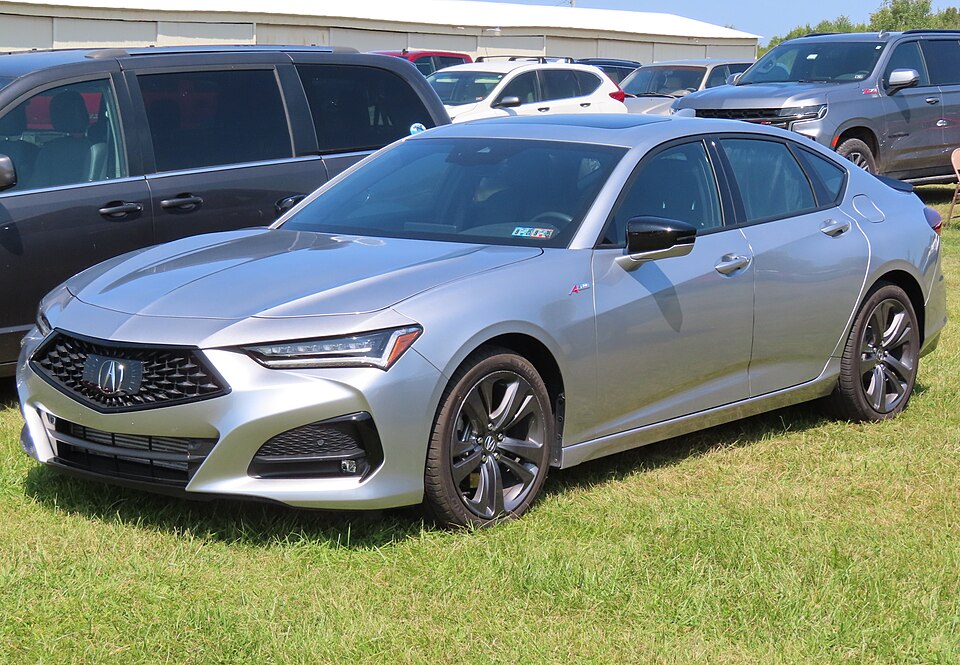
2020 Acura TLX
Gas Compact car
The 2020 Acura TLX is sold in the U.S. as a gas compact car with 6 EPA-rated configurations. The most efficient version, the TLX FWD, is EPA-rated at 27 mpg combined. NHTSA lists 5 recall campaigns for this model year, 1 rated critical, which gives it a Safety Signal grade of F. Owners have filed 62 complaints, most often about engine. NHTSA crash-tested it at 5 stars overall.
Specs & fuel economy (EPA)
| Configuration | Powertrain | Drive | Engine / motor | City | Hwy | Comb | Annual fuel* |
|---|---|---|---|---|---|---|---|
| TLX FWD | Gas | FWD | 2.4L 4-cyl | 23 | 33 | 27 | $2,850 |
| TLX FWD A-SPEC | Gas | FWD | 2.4L 4-cyl | 23 | 32 | 26 | $3,000 |
| TLX FWD | Gas | FWD | 3.5L 6-cyl | 20 | 31 | 24 | $3,250 |
| TLX AWD | Gas | AWD | 3.5L 6-cyl | 20 | 29 | 23 | $3,350 |
| TLX AWD A-SPEC | Gas | AWD | 3.5L 6-cyl | 20 | 29 | 23 | $3,350 |
| TLX FWD A-SPEC | Gas | FWD | 3.5L 6-cyl | 20 | 30 | 23 | $3,350 |
*EPA estimate at 15,000 miles/year and EPA reference fuel/electricity prices. Source: fueleconomy.gov vehicle records.
Out of factory warranty soon?
The 2020 Acura TLX is in the years where transmission, electronics and drivetrain repairs land on the owner. Compare extended-coverage quotes in about two minutes.
Compare coverage →Affiliate disclosure: some links on this page are affiliate links. If you request a quote or buy through them we may earn a commission at no extra cost to you. Data on this page is never influenced by that.
Recalls (5)
Air Bags
highProblem: Honda (American Honda Motor Co.) is recalling certain 2018-2021, 2023 Acura TLX, 2019-2024 RDX, 2017-2020, 2022-2026 MDX, 2017-2021, 2023, 2025 Honda Ridgeline, 2017-2022 Pilot, 2019-2021 Passport, 2018-2026 Odyssey, 2019-2022 Insight, 2019-2021 HR-V, 2018-2020 Fit, 2020-2022 CR-V Hybrid, 2017-2022 CR-V, 2017-2018, 2021 Civic Type R, 2017-2021 Civic hatchback, 2016-2020 Civic coupe, 2016-2022 Civic, 2017-2022 Accord Hybrid, and 2016-2022 Accord vehicles. The front passenger seat weight sensor may crack and short circuit, which can cause the air bags to deploy unintentionally during a crash.
Risk: Air bags that deploy unintentionally during a crash increase the risk of injury.
Fix: Dealers will replace the seat weight sensors, free of charge. Owner notification letters were mailed July 7, 2026. Owners may contact Honda's customer service at 1-888-234-2138. Honda's numbers for this recall are BOL, WO9, OOA, WOM, XOH, NOC, POD, BOE, UOF, POB, EOG, AOI, QO8, TOJ, DO7, and SOK. This recall expands previous NHTSA recall number 24V064. Vehicle Identification Numbers (VINs) involved in this recall will be searchable on NHTSA.gov beginning May 29, 2026.
Air Bags
highProblem: Honda (American Honda Motor Co.) is recalling certain 2020-2022 Pilot, Accord, Civic sedan, HR-V, Odyssey, 2020 Civic coupe, Fit, 2021-2022 Civic hatchback, 2021 Civic Type R, Insight, 2020-2021 CR-V, CR-V Hybrid, Passport, Ridgeline, Accord Hybrid, 2020 Acura MDX, 2022 Acura MDX, 2020-2022 Acura RDX, and 2020-2021 Acura TLX vehicles. The front passenger seat weight sensor may crack and short circuit, failing to suppress the air bag as intended.
Risk: An air bag that deploys unintentionally during a crash can increase the risk of injury.
Fix: Dealers will replace the seat weight sensors, free of charge. Owner notification letters were mailed March 28, 2024. This is a phased recall. Owners may contact Honda customer service at 1-888-234-2138. Honda's numbers for these recalls are XHP and VHQ.
Fuel System, Gasoline
highProblem: Honda (American Honda Motor Co.) is recalling certain 2013-2023 Honda Accord, Civic Coupe, Civic Sedan, Civic Hatchback, Civic Type R, CR-V, HR-V, Ridgeline, Odyssey, Acura ILX, MDX, MDX Hybrid, RDX, RLX, TLX, 2019-2022 Honda Insight, Passport, 2020 Honda CR-V Hybrid, 2018-2019 Honda Clarity PHEV, Fit, and 2015-2020 Honda Accord Hybrid, Pilot, Acura NSX vehicles. The fuel pump inside the fuel tank may fail.
Risk: Fuel pump failure can cause an engine stall while driving, increasing the risk of a crash.
Fix: Dealers will replace the fuel pump module, free of charge. Owner letters were mailed September 6, 2024. Owners may contact Honda customer service at 1-888-234-2138. Honda's numbers for this recall are KGC and KGD. This recall is an expansion of NHTSA recall numbers 21V-215 and 20V-314.
Engine And Engine Cooling
criticalProblem: Honda (American Honda Motor Co.) is recalling certain 2015-2020 Acura TLX, 2016-2020 Acura MDX, 2016 and 2018-2019 Pilot, 2017 and 2019 Ridgeline, and 2018-2019 Odyssey vehicles. Due to a manufacturing error, the connecting rod bearing in the engine may wear and seize, damaging the engine.
Risk: A damaged engine may run improperly or stall while driving, increasing the risk of a fire, crash, or injury.
Fix: Dealers will inspect and repair, or replace the engine as necessary, free of charge. Owner letters were mailed March 28, 2024. 2016-2017 Acura MDX owner letters were mailed November 1, 2024. 2016-2020 Acura MDX owner letters are expected to be mailed in mid-December 2024. Honda began mailing owner notification letters as of March 18, 2024. 2015-2016 Acura owner letters are expected to be mailed mid-December 2024, 2018 Acura TLX owner letters are expected to be mailed the end of March/early Apr
Fuel System, Gasoline
highProblem: Honda (American Honda Motor Co.) is recalling certain 2019-2020 Acura MDX, MDX Sport Hybrid, RDX, TLX, Honda Accord, Civic Hatchback, Insight, 2019 Acura ILX, Honda Accord Hybrid, Civic Coupe, Civic Coupe Si, Civic Sedan, Civic Sedan Si, Civic Type R, Fit, HR-V, Odyssey, Passport, Pilot and Ridgeline, and 2018-2019 CR-V vehicles. The low-pressure fuel pump inside the fuel tank may fail.
Risk: Fuel pump failure can cause an engine stall while driving, increasing the risk of a crash.
Fix: Honda will notify owners, and dealers will replace the fuel pump assembly, free of charge. Owner letters were mailed May 18, 2021. Owners may contact Honda customer service at 1-888-234-2138. Note: This recall is an expansion of recall 20V-314.
NHTSA investigations
Engine — Engine failure (open)
The Office of Defects Investigation (ODI) has received 414 reports of connecting rod bearing failures in the 3.5L V6 engine used in the following vehicles: Model Years (MY) 2018-2020 Acura TLX, MY2016-2020 Acura MDX, MY2016-2020 Honda Pilot, MY2018-2020 Honda Odyssey, and MY2017-2019 Honda Ridgeline. The subject engine failures were analyzed as part of a Recall Query (RQ24013). It was determined that these engine failures are outside the scope of Honda Recall 23V-751. Further, evidence gathered in conjunction with RQ24013 does not suggest this failure is caused by the same crankshaft manufacturing defect that is addressed by Honda in Recall 23V-751. Based on analysis of data from RQ240
Opened Aug 20, 2025 · action PE25008
Engine And Engine Cooling:Engine — No Restart After Auto Start/Stop Engages (open)
On June 3, 2022, the Office of Defects Investigation (ODI) opened Preliminary Evaluation PE22005 after the agency received VOQs and several �eld reports concerning the Auto Idle Stop (AIS) feature on 2016-2019MY Honda Pilot vehicles. The complaints allege that the engine fails to restart on its own from a complete stop at a traffic light or road intersection with the AIS function engaged. The subject vehicles are equipped with a 3.5L engine with a 9-speed automatic transmission. On January 6, 2023, Honda released service bulletins 23-008 and 23-009. These service bulletins address the failure to restart issue in the 2016-2019MY Honda Pilot vehicles, as well as the 2015-2020 Acura TLX, 2016
Opened Mar 26, 2025 · action EA25004
Engine — Engine failure (closed)
On November 8, 2024, the Office of Defects Investigation (ODI) opened Recall Query RQ24013 to assess the scope of Honda recall 23V-751 after receiving complaints that alleged connecting rod bearing failures in vehicles that were not within the scope of recall 23V-751. In November 2023, Honda recalled 248,999 various Model Year (MY)2016–2020 Honda and Acura vehicles equipped with the 3.5L V6 engine. Honda recalled these vehicles due to a crankshaft manufacturing defect that caused premature connecting rod bearing wear and engine seizure. While the out-of-scope failures involved in these complaints appear to have a very similar failure mechanism as the recalled engines, a thorough analysis o
Opened Nov 8, 2024 · closed Aug 20, 2025 · action RQ24013
Owner complaints
62 complaints filed
4 involved a crash, 0 a fire, 1 injuries, 0 deaths reported by owners.
Filed by year — 2020: 1 · 2021: 5 · 2022: 4 · 2023: 5 · 2024: 25 · 2025: 15 · 2026: 7
Most-cited components
- Engine — 19
- Fuel System, Gasoline — 12
- Forward Collision Avoidance — 10
- Electrical System — 9
- Engine And Engine Cooling — 8
Complaint counts are raw owner reports to NHTSA, not verified defects, and scale with how many were sold. Use them to spot patterns, not to rank.
Crash ratings
| Configuration | Overall | Frontal | Side | Rollover | Rollover risk |
|---|---|---|---|---|---|
| 4 DR AWD | ★★★★★ | ★★★★★ | ★★★★★ | ★★★★★ | 10% |
| 4 DR FWD | ★★★★★ | ★★★★★ | ★★★★★ | ★★★★★ | 10% |
NHTSA New Car Assessment Program. Standard driver-assist: forward collision warning, lane departure warning.
Other TLX model years
2025 TLX
2 recalls · 4 complaints
B2024 TLX
2 recalls · 5 complaints
D2023 TLX
4 recalls · 18 complaints
D2022 TLX
4 recalls · 33 complaints
F2021 TLX
5 recalls · 99 complaints
F2019 TLX
6 recalls · 92 complaints
D2018 TLX
4 recalls · 94 complaints
D2017 TLX
3 recalls · 71 complaints
D2016 TLX
3 recalls · 110 complaints
Sources & method
Safety Signal starts every model-year at 100 and subtracts points per open NHTSA recall campaign by severity: critical 15 (fire risk, park-outside or do-not-drive advisories), high 8 (brakes, steering, airbags, loss of drive power, structure, battery), moderate 6, minor 3 (software, labels, lighting fixed by an update). Floor 35. A ≥ 90, B ≥ 80, C ≥ 70, D ≥ 60, otherwise F. Complaint counts and NHTSA crash ratings are shown separately and are not blended into the grade.
EPA figures come from fueleconomy.gov vehicle records (ids 41333, 41334, 41335, 41337, 41338, 41336). Recalls, complaints, investigations and crash ratings come from NHTSA's public flat files, refreshed weekly.