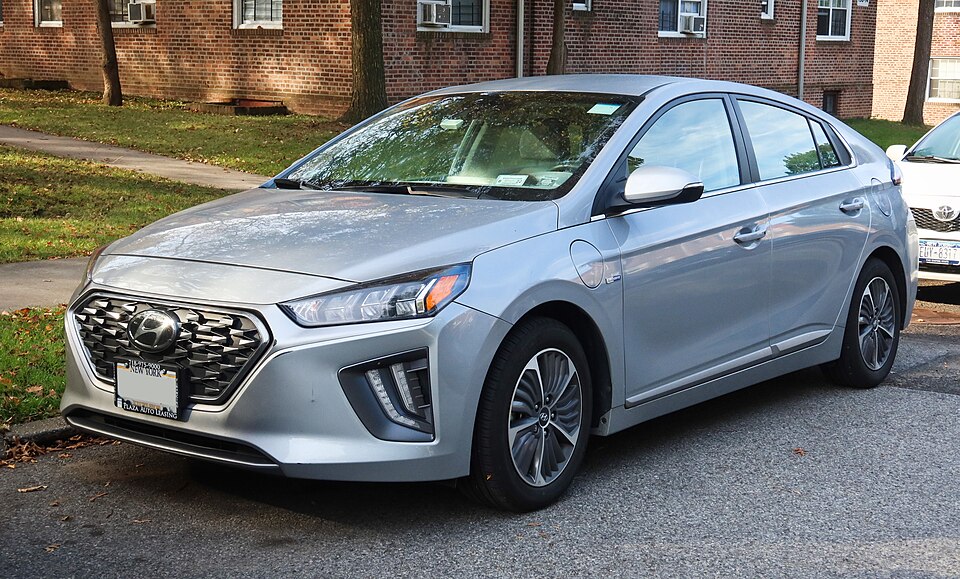
2018 Hyundai Ioniq
Electric Plug-in hybrid Hybrid Midsize car
The 2018 Hyundai Ioniq is sold in the U.S. as a electric, plug-in hybrid and hybrid midsize car with 4 EPA-rated configurations. Its longest-range version, the Ioniq Electric, is EPA-rated at 124 miles with 136 MPGe combined efficiency. NHTSA lists 3 recall campaigns for this model year, 2 rated critical, which gives it a Safety Signal grade of D. Owners have filed 17 complaints, most often about unknown or other.
Specs & fuel economy (EPA)
| Configuration | Powertrain | Drive | Engine / motor | City | Hwy | Comb | Range | kWh/100mi | Charge (240V) | Annual fuel* |
|---|---|---|---|---|---|---|---|---|---|---|
| Ioniq Electric | Electric | FWD | 88 kW AC PMSM | 150 | 122 | 136 MPGe | 124 mi | 25 | 4 h | $550 |
| Ioniq Plug-in Hybrid | Plug-in hybrid | FWD | 1.6L 4-cyl + 32kW IPMSM | 53 | 52 | 52 (76 MPGe blended) | 29 mi electric | 28 | 2.3 h | $1,200 |
| Ioniq Blue | Hybrid | FWD | 1.6L 4-cyl + 240V Li-Ion | 57 | 59 | 58 | — | — | — | $1,100 |
| Ioniq | Hybrid | FWD | 1.6L 4-cyl + 240V Li-Ion | 55 | 54 | 55 | — | — | — | $1,150 |
*EPA estimate at 15,000 miles/year and EPA reference fuel/electricity prices. Source: fueleconomy.gov vehicle records.
Out of factory warranty soon?
The 2018 Hyundai Ioniq is in the years where high-voltage electronics and module repairs land on the owner. Compare extended-coverage quotes in about two minutes.
Compare coverage →Affiliate disclosure: some links on this page are affiliate links. If you request a quote or buy through them we may earn a commission at no extra cost to you. Data on this page is never influenced by that.
Recalls (3)
Hybrid Propulsion System
criticalProblem: Hyundai Motor America (Hyundai) is recalling certain 2017-2018 Ioniq HEV and Ionic PHV vehicles previously recalled under recall number 18V-704. The Power Relay Assembly (PRA) located underneath the rear seat may overheat.
Risk: An overheated PRA increases the risk of a fire.
Fix: Dealers will inspect and replace the main relay or PRA, as necessary, free of charge. Owner notification letters were mailed August 23, 2022. Owners may contact Hyundai customer service at 1-855-371-9460. Hyundai's number for this recall is 232. This recall replaces NHTSA recall number 18V-704. Vehicles already repaired under the previous recall will need to have the new remedy completed.
Electrical System
minorProblem: Hyundai Motor America (Hyundai) is recalling certain 2017-2019 Ioniq electric vehicles. An unstable electrical ground may cause the vehicle to enter a fail-safe mode with reduced acceleration and power. In certain conditions while in fail-safe mode, the vehicle may accelerate after the gas pedal is released.
Risk: Unexpected acceleration following gas pedal release can increase the risk of a crash.
Fix: Dealers will update the EPCU (Electric Power Control Unit) software and repair the ground wiring, free of charge. Owner notification letters were mailed February 9, 2022. Owners may contact Hyundai customer service at 1-855-371-9460. Hyundai's number for this recall is 215.
Hybrid Propulsion System
criticalProblem: Hyundai Motor America (Hyundai) is recalling certain 2017-2018 Hyundai Ioniq Hybrid and 2018 Ioniq Plug-In Hybrid vehicles. The Main Relay within the Power Relay Assembly (PRA) may have inadequate connections between its contacts, causing increased electrical resistance.
Risk: The increased electrical resistance can overheat the rear seat which is above the PRA, increasing the risk of a fire.
Fix: Hyundai will notify owners, and dealers will inspect the Power Relay Assembly (PRA) for damage. If no damage is found, the main relay will be replaced. If damage is found, the PRA will be replaced. These repairs will be performed free of charge. The recall began February 28, 2019. Owners may contact Hyundai customer service at 1-855-371-9460. Hyundai's number for this recall is 178.
NHTSA investigations
Electrical System:Propulsion System — Pedestrian alert sounds (closed)
NHTSA received a petition on or about July 18, 2022, requesting that Federal Motor Vehicle Safety Standard (FMVSS) 141 be applied to all electric and hybrid vehicles operating in the United States. The petition can be reviewed at NHTSA.gov under ODI Number 11486072. FMVSS 141 establishes performance requirements for pedestrian alert sounds for motor vehicles. The standard applies to hybrid and electric vehicles that have a gross vehicle weight rating of 4,536 KG or less or are defined as low-speed vehicles. The standard became fully applicable to all such vehicles manufactured on or after March 1, 2021.On January 27, 2023, NHTSA opened Defect Petition (DP) 22-005 to evaluate the subject matt
Opened Jan 27, 2023 · closed Aug 7, 2023 · action DP22005
Owner complaints
17 complaints filed
2 involved a crash, 0 a fire, 2 injuries, 0 deaths reported by owners.
Filed by year — 2018: 4 · 2019: 2 · 2020: 1 · 2021: 1 · 2022: 3 · 2023: 1 · 2024: 3 · 2025: 1 · 2026: 1
Most-cited components
- Unknown Or Other — 4
- Electrical System — 3
- Engine — 3
- Power Train — 3
- Vehicle Speed Control — 2
Complaint counts are raw owner reports to NHTSA, not verified defects, and scale with how many were sold. Use them to spot patterns, not to rank.
Crash ratings
NHTSA has not published 5-Star crash ratings for this model year.
Other Ioniq model years
2022 Ioniq
0 recalls · 27 complaints
A2021 Ioniq
0 recalls · 20 complaints
B2020 Ioniq
1 recalls · 29 complaints
B2019 Ioniq
2 recalls · 32 complaints
F2017 Ioniq
5 recalls · 50 complaints
Sources & method
Safety Signal starts every model-year at 100 and subtracts points per open NHTSA recall campaign by severity: critical 15 (fire risk, park-outside or do-not-drive advisories), high 8 (brakes, steering, airbags, loss of drive power, structure, battery), moderate 6, minor 3 (software, labels, lighting fixed by an update). Floor 35. A ≥ 90, B ≥ 80, C ≥ 70, D ≥ 60, otherwise F. Complaint counts and NHTSA crash ratings are shown separately and are not blended into the grade.
EPA figures come from fueleconomy.gov vehicle records (ids 39641, 39768, 39614, 39615). Recalls, complaints, investigations and crash ratings come from NHTSA's public flat files, refreshed weekly.