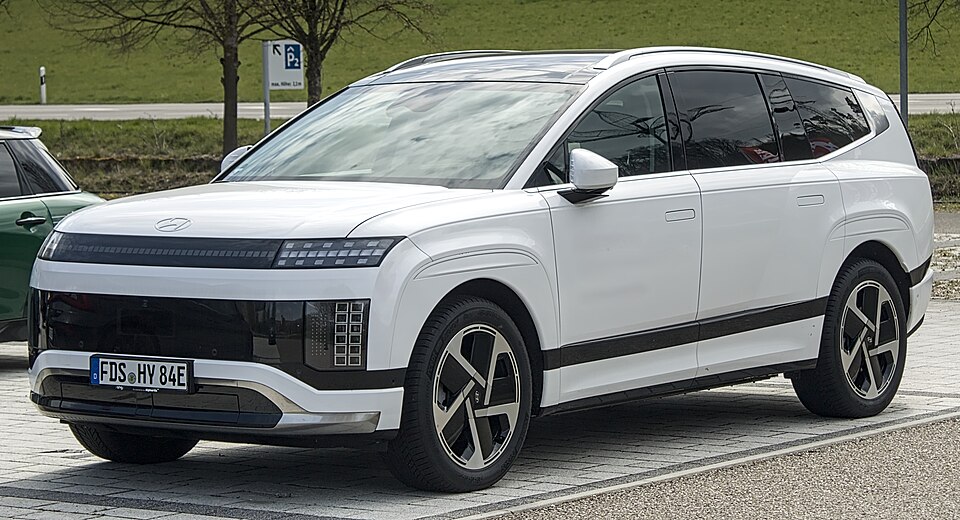
2026 Hyundai Ioniq 9
The 2026 Hyundai Ioniq 9 is sold in the U.S. as an electric large SUV with 3 EPA-rated configurations. Its longest-range version, the Ioniq 9 RWD, is EPA-rated at 335 miles with 92 MPGe combined efficiency. NHTSA lists 3 recall campaigns for this model year, 1 rated critical, which gives it a Safety Signal grade of C. Owners have filed 37 complaints, most often about the electrical system. NHTSA crash-tested it at 5 stars overall. Manufacturer pricing runs from $58,955 to $76,490 across 6 trims.

| Trim | Powertrain | Drive | MSRP | HP | Torque | MPG comb | Seats | Cargo (2nd row) | Wheels |
|---|---|---|---|---|---|---|---|---|---|
| S | Electric | RWD | $58,955 | 215 hp | 258 lb-ft | 92 MPGe | 7 | 46.7 cu-ft | 19 in |
| SE | Electric | AWD | $62,765 | 303 hp | 446 lb-ft | 88 MPGe | 7 | 46.7 cu-ft | 20 in |
| SEL | Electric | AWD | $66,320 | 303 hp | 446 lb-ft | 88 MPGe | 7 | 46.7 cu-ft | 20 in |
| Limited | Electric | AWD | $71,250 | 422 hp | 516 lb-ft | 85 MPGe | 6 | 46.7 cu-ft | 21 in |
| Calligraphy | Electric | AWD | $74,990 | 422 hp | 516 lb-ft | 85 MPGe | 6 | 46.7 cu-ft | 21 in |
| Calligraphy Design | Electric | AWD | $76,490 | 422 hp | 516 lb-ft | 85 MPGe | 6 | 46.7 cu-ft | 21 in |
MSRP excludes destination. Open a trim for the complete spec sheet and standard/optional equipment. Have the car in front of you? Decode its VIN to see which of these trims it is and what it was priced at.
Specs & fuel economy
Source: EPA fueleconomy.gov| Configuration | Powertrain | Drive | Engine / motor | City | Hwy | Comb | Range | kWh/100mi | Charge (240V) | Annual fuel* |
|---|---|---|---|---|---|---|---|---|---|---|
| Ioniq 9 RWD | Electric | RWD | 160 kW PMSM | 103 | 81 | 92 MPGe | 335 mi | 37 | 11.7 h | $850 |
| Ioniq 9 AWD | Electric | AWD | 66 and 160 kW PMSM | 98 | 78 | 88 MPGe | 320 mi | 38 | 11.6 h | $850 |
| Ioniq 9 AWD Performance | Electric | AWD | 157 kW PMSM (IPM) | 91 | 79 | 85 MPGe | 311 mi | 40 | 11.5 h | $900 |
*EPA estimate at 15,000 miles/year at EPA reference fuel and electricity prices. fueleconomy.gov record ids: 49661, 49662, 49663.
The cheapest ownership win
Insurers price the 2026 Ioniq 9 very differently, and the gap between the best and worst quote on the same car and driver is usually larger than any option you are weighing on this page.
How to compare cover →Affiliate disclosure: some links on this page are affiliate links. If you request a quote or buy through them we may earn a commission at no extra cost to you. Nothing on this page changes because of it.
Recalls (3)
Source: NHTSA recall databaseSuspension
303Electrical System
294These are vehicle campaigns — the ones the automaker filed against this model. NHTSA also records equipment recalls, filed by a parts maker against a component (a tyre, a child seat, an aftermarket part), and those are not listed here or counted above. nhtsa.gov/recalls shows both for a VIN.
Whether any of this applies to one specific Ioniq 9
A campaign covers a build range, not a model year, so two identical-looking cars from 2026 can differ. Both of these check a VIN against the manufacturer’s own list, free, in about ten seconds. Hyundai publishes its own lookup because federal rule 49 CFR 573.15 requires it to, and to keep it current to within seven days.
Hear about a recall before the letter does
The manufacturer’s letter is the last step of a recall: it has up to 60 days after filing to mail owners, at the address on the registration. We email you the day NHTSA posts a recall on the 2026 Hyundai Ioniq 9, with what to do next. Nothing else, ever — no newsletter, no marketing, one-click unsubscribe in every message.
Parts & accessories for the 2026 Hyundai Ioniq 9
Search by fitment on eBay Motors — OEM take-offs, aftermarket, and the trim pieces dealers no longer stock. The listing and the price are the seller's.
Find parts for this Ioniq 9 →Owner complaints
Source: NHTSA complaint database0 involved a crash · 0 a fire · 4 injuries · 0 deaths reported
30 per 10,000 built · Hyundai reported 12,147 Ioniq 9 built (its Early Warning production report to NHTSA)
Filed per year: 2025: 4 · 2026: 33
Most-cited components
In owners' own words
Filed with NHTSA by the people who own these cars, one per problem area. Quoted as written, with anything identifying removed.
My 2026 Hyundai Ioniq 9 (Performance Calligraphy AWD), leased new in late April 2026 from Team Hyundai of Bend, OR, suffered an Integrated Charging Control Unit (ICCU) failure at approximately 1500 miles in late June 2026, roughly two months into ownership. The failure progressed over several days.
I was driving at 35 mph speed on a straight road and the car automatically activated emergency steering and pushed towards right I had to jerk the steering towards left to prevent any accidents. No adverse event occurred however this was unnerving experience
The motorized flush door handles lack an automatic anti-pinch resistance sensor when retracting. If an object, hand, or child’s finger is caught inside the door handle while the vehicle locks, the motor continues to force the handle shut. This creates a severe crushing and entrapment hazard. This is available for inspection upon request.
On May 14, 2026, while traveling at highway speed in a clear passing lane with no obstacles present, the autonomous emergency braking system activated without cause and brought the vehicle to a complete stop. A following vehicle nearly rear-ended me. I recorded a voice memo immediately after the incident.
Vehicle was operating perfect then got alert indicating electrical system fault but vehicle still drove (was just 2 miles from home ) but then alarms sounded and just able to pull off road before vehicle died. Checked and see code DTC PIA9096 and car was inoperable after. Towed to dealer for replacement of ICCU module.
Two safety incidents occurred (October and November 2025) involving the power-folding second-row seats. A child was seated in the second-row captain’s chair when a sibling activated the seat from the third row. The seat failed to detect the occupant and continued moving forward, creating a crushing hazard.
Complaint counts are raw owner reports to NHTSA, not verified defects, and scale with how many were sold. Use them to spot patterns, not to rank.
Reported by Hyundai itself: 5 death-or-injury claims on this model year in its quarterly Early Warning reports to NHTSA (49 CFR 579.21): 8 injured, as claimed, not verified — about 41 per 100,000 built. Every Ioniq 9 model year, by year and system → Dated and by system, they are exhibit F of the defect dossier.
Crash ratings
Source: NHTSA NCAP| Configuration | Overall | Frontal | Side | Rollover | Rollover risk |
|---|---|---|---|---|---|
| SUV AWD | ★★★★★ | ★★★★★ | ★★★★★ | ★★★★★ | 10% |
| SUV RWD | ★★★★★ | ★★★★★ | ★★★★★ | ★★★★★ | 10% |
NHTSA New Car Assessment Program.
Service bulletins & campaigns
Source: NHTSA manufacturer communications- Term not in NHTSA’s summary · Hyundai warranty extension LA32Certain Palisade Hybrid (LX3 HEV) vehicles may illuminate the Malfunction Indicator Lamp (MIL) and display a false “Check Hybrid System” warning message after use of Bluelink Remote Start following…
- Term not in NHTSA’s summary · Hyundai warranty extension LA9Certain IONIQ 5 (NEA EV) and IONIQ 9 (ME1A EV) vehicles (affected VINs listed below) may exhibit a high-frequency noise from the front motor area during low-speed deceleration.
The term and the vehicles it covers are the manufacturer’s, as NHTSA’s summary of each filing states them; a dealer checks one particular car by its VIN. Every Hyundai warranty extension (62) → · Every warranty extension on file, all makes →
Most often about: Electrical System, Seats, Exterior Lighting, Unknown Or Other, Air Bags.
- 26-EV-006H TSB Service bulletin2026-08-19 · Fuel/Propulsion System
- Some IONIQ 9 (ME1A EV) vehicles may illuminate a MIL warning light with DTC P0AA600 and/or P1AA800 with limited charging capabilities. This bulletin provides instructions to replace the Battery System Assembly (BSA) if necessary.
- 26-01-053H-1 TSB Warranty extension2026-08-11 · Electrical System
- Certain IONIQ 9 (ME1A EV) vehicles may exhibit a Data Communication Unit (DCU) software error due to the internal timer initialization logic not being implemented. The DCU module may shut down telematics services after one year. This bulletin provides instructions to perform a software update for the DCU module.
- 11032523 Other2026-04-10 · Air Bags
- The National Highway Traffic Safety Administration (NHTSA) has identified the presence of substandard and dangerous driver’s-side airbag inflators manufactured by Jilin Province Detiannuo Automobile Safety System Co., Ltd. (DTN). These inflators were not supplied, approved, or authorized by the vehicle manufacturers and have primarily been found in vehicles that previously experienced a crash and
- 11032522 Other2026-04-10 · Air Bags
- The National Highway Traffic Safety Administration (NHTSA) has issued an urgent safety advisory regarding dangerous, counterfeit driver‑side airbag inflators manufactured by Jilin Province Detiannuo Automobile Safety System Co., Ltd. (DTN), that have been identified in U.S. vehicles following prior crashes, theft, or non‑certified airbag replacements. These inflators are not approved for use, may
- 26-01-029H TSB Warranty extension2026-03-17 · Power Train
- Certain IONIQ 5 (NEA EV) and IONIQ 9 (ME1A EV) vehicles (affected VINs listed below) may exhibit a high-frequency noise from the front motor area during low-speed deceleration. This bulletin provides instructions to replace the front motor and gear reduction assembly.
- 26-01-020H TSB Service campaign2026-02-24 · Unknown Or Other
- Certain IONIQ 9 (ME1A EV) vehicles may have a sliding center console (rear floor console) that makes a ratcheting noise while being moved forward or backward. This bulletin provides instructions to remove and replace the affected sliding center console.
- 26-01-001H DCS Service campaign2026-01-09 · Exterior Lighting
- Certain IONIQ 9 (ME1A EV) vehicles may exhibit adhesive residue on the high mounted stop lamp. This can occur when the clear protective film has had prolonged exposure to sun and heat, causing some of the adhesive to remain on the black plastic housing after removal. Technical Service Bulletin (TSB) 26-01-001H provides instructions to inspect and, if necessary, replace the high mounted stop lamp o
- 25-BD-012H TSB Service bulletin2025-11-06 · Exterior Lighting
- This bulletin provides information regarding condensation related to the accumulated moisture in the headlamp, rear combination lamp, daytime running lamp (DRL), or fog lamp. This TSB illustrates the various causes of condensation inside the lamp assembly. Lamp assembly replacement is NOT necessary in most cases. This condition can be eliminated by turning on the lamps with the engine running for
A service bulletin is the manufacturer telling its dealers how to diagnose or repair a known condition. It is not a recall, not a finding that the vehicle is defective, and the work is not automatically free — though a bulletin is often what a dealer works from when you describe a symptom, so quoting the document number can save a diagnosis. The count is every communication filed; the list shows the most recent, one entry per campaign, because a single campaign is usually filed as several documents on the same day. The summaries are NHTSA's; the full documents come from the manufacturer.
Ioniq 9 by model year
all years, side by side →Common questions about the 2026 Ioniq 9
Source: EPA, NHTSA and manufacturer press kitsHow much does the 2026 Hyundai Ioniq 9 cost?
Manufacturer pricing runs from $58,955 for the S RWD to $76,490 for the Calligraphy Design AWD, across 6 trims. Those are MSRPs from the manufacturer's own press material; they exclude destination, options, taxes and whatever the dealer adds. Every trim and price is listed above.
Does the 2026 Hyundai Ioniq 9 have any recalls?
NHTSA has posted 3 recall campaigns for the 2026 Hyundai Ioniq 9, 1 of them rated critical. The most serious on file is 26V068000, covering Electrical System. Check your own VIN at nhtsa.gov/recalls; a recall applies to specific build ranges, not every car.
How safe is the 2026 Hyundai Ioniq 9?
NHTSA gave the 2026 Hyundai Ioniq 9 5 stars overall in its New Car Assessment Program tests — 5-star frontal crash, 5-star side crash, 5-star rollover. WhichTrim also grades it C (72/100) on its recall record, which is a different question from crash protection.
What is the fuel economy of the 2026 Hyundai Ioniq 9?
Across the 3 EPA-rated configurations of the 2026 Hyundai Ioniq 9, the longest EPA range is 335 miles on a charge. Figures are the EPA's own, per configuration, and every one is listed above.
What do owners complain about on the 2026 Hyundai Ioniq 9?
Owners have filed 37 complaints with NHTSA about the 2026 Hyundai Ioniq 9, most often about electrical system, forward collision avoidance, fuel/propulsion system. Of those, 4 reported injuries. Complaints are unverified owner reports, so treat the pattern as a signal and the individual report as an anecdote.
Are there service bulletins for the 2026 Hyundai Ioniq 9?
The manufacturer has filed 17 service bulletins and related communications with NHTSA for the 2026 Hyundai Ioniq 9, most often covering electrical system, seats, exterior lighting. The most recent is dated 2026-08-19. A bulletin is not a recall: it is the repair procedure a manufacturer sends its dealers for a condition it knows about, and the work is not automatically paid for. It is still worth knowing — if the symptom matches, quoting the bulletin number at the service desk can save a diagnosis. The document numbers and summaries are listed above.
Which 2026 Hyundai Ioniq 9 trim is the best value?
$17,535 separates the cheapest of the 6 trims from the most expensive, so the answer depends on which of the differences you would actually use. Every trim has its own page here with the manufacturer's full specification and equipment list, plus a short summary of exactly what it adds over the base trim — worth reading before a dealer frames the walk-up for you. The trim-by-trim ladder shows what every step up costs and what it makes standard.
What we hold, and what an empty row means
Paid vehicle-history reports will not tell you the difference between “nothing happened to this car” and “we never received that record” — both of the big two say as much in their own help pages. Most of what is on this page comes from complete federal registers, so we can tell you which is which, row by row.
| Data | Held | Source | What it covers — or what empty means |
|---|---|---|---|
| Fuel economy & configurations | 3 configurations | EPA certification records | Every configuration the EPA certified for sale, with its own test figures. |
| Emission certificates | none | EPA emission certificates | The EPA published no certificate we could match to a configuration on this page. |
| Recalls | 3 | NHTSA recall campaigns | A complete federal register: every campaign covering this model year, with severity and advisory flags. |
| Owner complaints | 37 | NHTSA complaint database | Also complete, but unverified: these are reports owners filed, not findings. Counts scale with how many were sold. |
| Crash ratings | 2 tested | NHTSA NCAP | Only the configurations NHTSA chose to crash-test, which is never all of them. |
| Service bulletins | 17 | NHTSA manufacturer communications | Everything the manufacturer told its dealers about a defect or malfunction, short of a recall. |
| Investigations | none | NHTSA Office of Defects Investigation | No defect investigation has been opened. |
| Driver-assist crash reports | none | NHTSA Standing General Order 2021-01 | No report has been filed. Only entities named in the order report, and only crashes they hear of — so this is also what an unequipped car, or a manufacturer without telematics, looks like. |
| Specifications filed with NHTSA | none | NHTSA vPIC, decoded from VIN patterns | We had no VIN pattern to decode for this model year, or the manufacturer filed nothing usable. |
| Trims, pricing & equipment | 6 trims | Manufacturer press kit | Transcribed from the manufacturer's own press material, every value carrying the document it came from. |
Rebuilt nightly; this page was generated 2026-10-26. Every figure above is traceable to the source named beside it, and the JSON for this page carries the same values with their identifiers.
Sources & method
Safety Signal starts every model-year at 100 and subtracts points per open NHTSA recall campaign by severity: critical 15 (fire risk, park-outside or do-not-drive advisories), high 8 (brakes, steering, airbags, loss of drive power, structure, battery), moderate 6, minor 3 (software, labels, lighting fixed by an update). The most serious recall counts in full and each further one counts 85% of the one before, because a vehicle sold in millions is recalled more often than a rare one without being more dangerous — and because a flat subtraction bottomed the scale out, scoring a vehicle with 22 recalls within a point of one with six. A ≥ 90, B ≥ 80, C ≥ 70, D ≥ 60, otherwise F. Read it as what it counts: recall campaigns on the federal record, weighted by severity. The damping reduces the sales bias by roughly 40% but does not remove it: like our complaint counts, this is not normalized by how many were sold, so a best-seller still scores somewhat worse than an obscure model with the same real risk. NHTSA crash ratings, do-not-drive and park-outside advisories, and the crash, fire, injury and death counts in owner complaints are reported separately on every page and never blended into the letter — a vehicle can hold five stars and a poor letter at once, and where that happens we say so rather than leave you to notice. Because the scale subtracts from a clean sheet, a model year too new to have been recalled, complained about or bulletined scores full marks on an empty record; we label those grades provisional rather than present them as earned.
EPA figures come from fueleconomy.gov vehicle records. Recalls, complaints, investigations and crash ratings come from NHTSA's public flat files, refreshed nightly. Trim-level specifications and pricing are transcribed from the manufacturer's official press kit; every value carries its source in the data file.