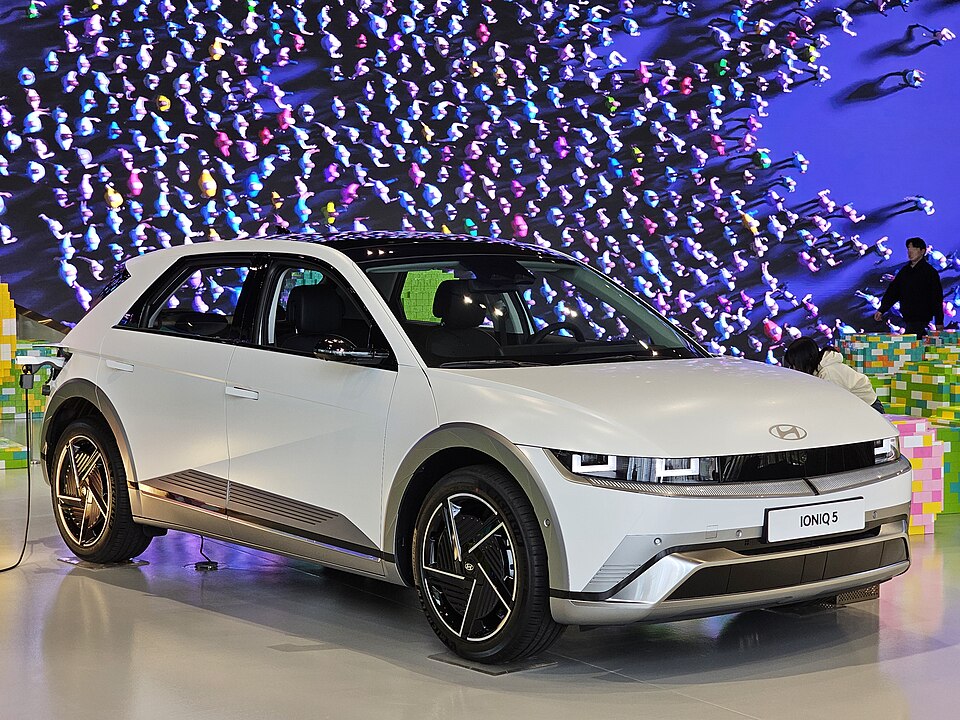
The 2025 Hyundai Ioniq 5 is sold in the U.S. as an electric compact SUV with 7 EPA-rated configurations. Its longest-range version, the Ioniq 5 RWD, is EPA-rated at 318 miles with 114 MPGe combined efficiency. NHTSA lists 9 recall campaigns for this model year, 3 rated critical, which gives it a Safety Signal grade of F. Owners have filed 317 complaints, most often about the electrical system. Manufacturer pricing runs from $42,600 to $66,200 across 9 trims.
MSRP excludes destination. Open a trim for the complete spec sheet and standard/optional equipment. Have the car in front of you? Decode its VIN to see which of these trims it is and what it was priced at.
Specs & fuel economy
Source: EPA fueleconomy.gov
Configuration
Powertrain
Drive
Engine / motor
City
Hwy
Comb
Range
kWh/100mi
Charge (240V)
Annual fuel*
Ioniq 5 Standard range
Electric
RWD
125 kW PMSM
131
100
115 MPGe
245 mi
29
6.3 h
$650
Ioniq 5 RWD
Electric
RWD
168 kW PMSM
129
100
114 MPGe
318 mi
30
9.1 h
$700
Ioniq 5 AWD (19 inch Wheels)
Electric
AWD
74 and 165 kW PMSM
116
96
106 MPGe
290 mi
31.7
8.2 h
$700
Ioniq 5 AWD (20 inch Wheels)
Electric
AWD
74 and 165 kW PMSM
108
88
98 MPGe
269 mi
34.5
8.2 h
$800
Ioniq 5 AWD XRT
Electric
AWD
74 and 165 kW PMSM
103
85
94 MPGe
259 mi
35.8
8.2 h
$800
Ioniq 5 N
Electric
AWD
166 and 282 kW PMSM
84
72
78 MPGe
221 mi
43
8.7 h
$950
Ioniq 5 Robo taxi
Electric
RWD
168 kW PMSM
73
69
71 MPGe
168 mi
47.5
10.3 h
$1,050
*EPA estimate at 15,000 miles/year at EPA reference fuel and electricity prices. fueleconomy.gov record ids: 48714, 48713, 48710, 48711, 48712, 48360, 49092.
Emissions & certification
Source: EPA emission certificates
Configuration
Smog rating
Emission standard
Where it can be sold new
SmartWay
Ioniq 5 AWD (19 inch Wheels), Ioniq 5 AWD (20 inch Wheels), Ioniq 5 RWD, Ioniq 5 Robo taxi, Ioniq 5 Standard range
10 / 10
Federal Tier 3 Bin 0 / California ZEV
All 50 states (federal, all altitudes); California and states following California standards
SmartWay Elite
Ioniq 5 AWD XRT, Ioniq 5 N
10 / 10
California ZEV / Federal Tier 3 Bin 0
All 50 states (federal, all altitudes); California and states following California standards
SmartWay Elite
Certified for all fifty states, so it can be registered new anywhere in the U.S.
The smog rating scores tailpipe pollutants other than greenhouse gases, 1 (worst) to 10 (best), and is comparable only within a model year. The standard is the federal bin or California tier the configuration was certified to. Both come from the EPA certificate behind the window sticker.
Insurers price the 2025 Ioniq 5 very differently, and the gap between the best and worst quote on the same car and driver is usually larger than any option you are weighing on this page.
Affiliate disclosure: some links on this page are affiliate links. If you request a quote or buy through them we may earn a commission at no extra cost to you. Nothing on this page changes because of it.
Recalls (9)
Source: NHTSA recall database
▲high
Suspension
303
172 vehiclesbuilt Dec 10, 2024 – Jul 10, 2025
ProblemHyundai Motor America (Hyundai) is recalling certain 2025 Ioniq 5 and 2026 Ioniq 9 vehicles.The fasteners for the rear suspension may loosen and detach, which can result in a loss of vehicle control.RiskA loss of vehicle control increases the risk of a crash.FixDealers will inspect and replace the rear suspension fasteners and perform a rear vehicle alignment, as necessary, free of charge. Owner notification letters are expected to be mailed July 17, 2026. Owners may contact Hyundai customer service at 1-855-371-9460. Hyundai's number for this recall is 303. Vehicle Identification Numbers (VINs) involved in this recall became searchable on NHTSA.gov on May 20, 2026.
ProblemHyundai Motor America (Hyundai) is recalling certain 2025-2026 IONIQ 5 and 2026 IONIQ 9 vehicles.The high voltage battery system may contain an improperly tightened bus bar, which can cause a short-circuit.RiskAn electrical short in the high voltage battery system increases the risk of a fire.FixDealers will inspect and tighten the bus bar retention bolts and replace the battery system assembly, as necessary, free of charge. Owner notification letters were mailed April 3, 2026. Owners may contact Hyundai customer service at 1-855-371-9460. Hyundai's number for this recall is 294. Vehicle Identification Numbers (VINs) involved in this recall became searchable on NHTSA.gov on February 7, 2026.
1,535 vehicles68% reported repairedbuilt Dec 12, 2024 – Jun 12, 2025
ProblemHyundai Motor America (Hyundai) is recalling certain 2025 IONIQ 5 vehicles.The seat belt retractors for the driver and front passenger seats may not be securely fastened.RiskAn improperly secured seat belt retractor may not function properly in a crash, increasing the risk of injury.FixDealers will inspect and secure the seat belt retractors, as necessary, free of charge. Owner notification letters were mailed December 30, 2025. Owners may contact Hyundai customer service at 1-855-371-9460. Hyundai's number for this recall is 287. Vehicle Identification Numbers (VINs) involved in this recall became searchable on NHTSA.gov on November 19, 2025.
8 vehicles62% reported repairedbuilt Dec 17, 2024 – Mar 25, 2025
ProblemHyundai Motor America (Hyundai) is recalling certain 2025 IONIQ 5 electric vehicles.Certain rear suspension alignment adjustment bolts may have been improperly tightened, which can cause a loss of vehicle stability control.RiskA loss of vehicle stability control increases the risk of a crash.FixDealers will replace the adjustment bolts, align the wheels, and replace tires if necessary, free of charge. Owner notification letters were mailed October 10, 2025. Owners may contact Hyundai customer service at 1-855-371-9460. Hyundai's number for this recall is 284. Vehicle Identification Numbers (VINs) involved in this recall became searchable on NHTSA.gov on September 13, 2025.
Park outside10 vehicles90% reported repairedbuilt Jun 12, 2025 – Jun 13, 2025
ProblemHyundai Motor America (Hyundai) is recalling certain 2025 IONIQ 5 vehicles.The high voltage battery system may contain an improperly tightened bus bar, which can cause a short-circuit.RiskAn electrical short in the high voltage battery system increases the risk of a fire.FixOwners are advised to park their vehicles outside and away from structures until the recall remedy is complete. Dealers will inspect and repair the high voltage battery system, as necessary, free of charge. Owner notification letters were mailed August 25, 2025. Owners may contact Hyundai customer service at 1-855-371-9460. Hyundai's number for this recall is 280.
10,409 vehicles99% reported repairedbuilt Nov 12, 2024 – Mar 20, 2025
ProblemHyundai Motor America (Hyundai) is recalling certain 2025 Hyundai IONIQ 5 vehicles.The right-side headlight may have an incorrect headlight aim label, which can result in improperly aimed headlights. As such, these vehicles fail to comply with the requirements of Federal Motor Vehicle Safety Standard number 108, "Lamps, Reflective Devices, and Associated Equipment."RiskImproperly aimed headlights can result in insufficient illumination of the road, decreasing the driver's visibility and increasing the risk of a crash.FixHyundai will mail owners a corrected label with inspection and installation instructions. Owners may bring their vehicle to a dealer for the repair, free of charge. Owner notification letters were mailed July 15, 2025. Owners may contact Hyundai customer service at 1-855-371-9460. Hyundai's number for this recall is 279.
1,589 vehicles97% reported repairedbuilt Dec 18, 2023 – Jan 7, 2025
ProblemHyundai Motor America (Hyundai) is recalling certain 2025 Hyundai IONIQ 5 "N" vehicles equipped with left-foot braking (LFB) and N e-shift features.The integrated electronic brake (IEB) and vehicle control unit (VCU) software may cause reduced braking performance when LFB is activated. Additionally, the vehicle may continue to accelerate after the pedal is released and the vehicle's N e-shift feature is engaged.RiskReduced braking performance and unexpected, continued acceleration increase the risk of a crash.FixOwners are advised not to use the LFB or N e-Shift features until the remedy has been performed. The IEB and VCU software will be updated over-the-air (OTA) or by a dealer, free of charge. Owner notification letters were mailed April 25, 2025. This recall replaces NHTSA recall number 25V-065. Vehicles repaired under the previous recall will need to have the new remedy completed. Owners may contact Hyundai customer service at 1-855-371-9460. Hyundai's number for this recall is 277.
33 vehicles85% reported repairedbuilt Nov 12, 2024 – Jan 7, 2025
ProblemHyundai Motor America (Hyundai) is recalling certain 2025 IONIQ 5 EV vehicles.The rear floor wiring harness may contain an open circuit, which can result in the rear side air bag not deploying as intended.RiskA rear side air bag that does not deploy as intended can increase the risk of injury in a crash.FixDealers will inspect and replace the rear floor wiring harness, as necessary, free of charge. Owner notification letters were mailed March 12, 2025. Owners may contact Hyundai customer service at 1-855-371-9460. Hyundai's number for this recall is 274.
ProblemHyundai Motor America (Hyundai) is recalling certain 2025 Hyundai IONIQ 5 "N" vehicles equipped with a left-foot braking (LFB) feature.The integrated electronic brake (IEB) and vehicle control unit (VCU) software may cause reduced braking performance when LFB is activated.RiskReduced braking performance can increase the distance required to stop the vehicle, increasing the risk of a crash.FixOwners who have not received the recall remedy are advised not to use the LFB feature until the updated remedy has been performed. Additionally, owners who have received the recall remedy are advised not to use the 'N' E-shift feature until the updated remedy has been performed. Dealers will update the IEB and VCU software, free of charge. Owner notification letters were mailed March 12, 2025. This recall is replaced by NHTSA recall number 25V-235. Vehicles already repaired under this recal
These are vehicle campaigns — the ones the automaker filed against this model. NHTSA also records equipment recalls, filed by a parts maker against a component (a tyre, a child seat, an aftermarket part), and those are not listed here or counted above. nhtsa.gov/recalls shows both for a VIN.
Whether any of this applies to one specific Ioniq 5
A campaign covers a build range, not a model year, so two identical-looking cars from 2025 can differ. Both of these check a VIN against the manufacturer’s own list, free, in about ten seconds. Hyundai publishes its own lookup because federal rule 49 CFR 573.15 requires it to, and to keep it current to within seven days.
The manufacturer’s letter is the last step of a recall: it has up to 60 days after filing to mail owners, at the address on the registration. We email you the day NHTSA posts a recall on the 2025 Hyundai Ioniq 5, with what to do next. Nothing else, ever — no newsletter, no marketing, one-click unsubscribe in every message.
Advertisement
Parts & accessories for the 2025 Hyundai Ioniq 5
Search by fitment on eBay Motors — OEM take-offs, aftermarket, and the trim pieces dealers no longer stock. The listing and the price are the seller's.
Filed with NHTSA by the people who own these cars, one per problem area. Quoted as written, with anything identifying removed.
Integrated Charging Control Unit (ICCU) failed while driving. Heard a pop from below the rear seats. "Check vehicle electrical system" message popped up initially, then changed to "Stop vehicle and check power supply" Vehicle could not exceed 20mph directly after failure, then lost all driving power just as I pulled the vehicle off the…
Electrical SystemFeb 24, 2026NHTSA owner report · ODI 11720305
I notice a strange pulsing/hesitation when accelerating at partial throttle (maybe 10-25%) between 60-65MPH. It's quite alarming, because it feels like the electric motor is cutting out momentarily.
Fuel/Propulsion SystemAug 25, 2025NHTSA owner report · ODI 11682918
ICCU failure and fuse, the car became unoperational and needed to stop. The car would no longer charge the 12V battery, and the EV battery would not charge. Hybrid Control Problem Detected at 3,160 miles. DTC P056216
Power TrainJan 28, 2026NHTSA owner report · ODI 11713949
Ioniq 5's yellow air bag wire/harness underneath driver seat has design flaw, many other owners are noticing. In my case the cables are touching the floor, it's a hazard
Air BagsOct 11, 2025NHTSA owner report · ODI 11692766
Description of Defect/Incident Model and Feature: This complaint concerns a significant safety defect in the Driver Attention Monitoring System (DAMS), which is specifically the Forward Attention Warning (FAW) feature, on the 2025 Hyundai Ioniq 5.
Lane DepartureOct 5, 2025NHTSA owner report · ODI 11691481
Since I have purchased the car it has: 1) the car has failed and stopped moving 3 separate times. It only has 290 miles on it. 1) been unable to charge on AC power (L1 and L2 chargers) 2) barely able to charge on DC chargers. 325kwh Tesla supercharger gave 9kwh
EngineAug 31, 2025NHTSA owner report · ODI 11684205
Complaint counts are raw owner reports to NHTSA, not verified defects, and scale with how many were sold. Use them to spot patterns, not to rank.
Reported by Hyundai itself: 1 death-or-injury claim on this model year in its quarterly Early Warning reports to NHTSA (49 CFR 579.21): 2 injured, as claimed, not verified — about 2.4 per 100,000 built. Every Ioniq 5 model year, by year and system → Dated and by system, they are exhibit F of the defect dossier.
Crash ratings
Source: NHTSA NCAP
Configuration
Overall
Frontal
Side
Rollover
Rollover risk
SUV AWD
not rated
not rated
not rated
★★★★★
8%
SUV RWD
not rated
not rated
not rated
★★★★★
8%
NHTSA New Car Assessment Program. Standard driver-assist: forward collision warning, lane departure warning, automatic emergency braking.
Driver-assist crash reports (54)
Source: NHTSA Standing General Order 2021-01
54reports filed
11 no injury reported · 43 severity unknown
Sep 2025 to Jul 2026 · 5 with an air bag deployment · 12 towed
What was engaged, and what was hit
System named: v1.0 (33), RC-03-27 (5), RC-01-23 (4), - (2)
Crash partner: SUV 16 · Passenger Car 15 · Pickup Truck 12 · Other 7
The reporting entity’s narrative as NHTSA published it, with anything identifying removed and nothing added. A narrative is a notice, written before the entity had verified what happened.
On April [redacted], 2026 at 11:47 PM, an AVRIDE autonomous vehicle(the "AVRIDE AV") was in a collision in Dallas, TX on [redacted] near [redacted]. The AVRIDE AV was stopped at a red light facing westbound on [redacted] in autonomous mode behind an SUV.
On March [redacted], 2026 at 1:44 PM, an AVRIDE autonomous vehicle (the "AVRIDE AV") was in a collision in Dallas, Texas on [redacted] near [redacted]. The AVRIDE AV was traveling northbound in the right lane on [redacted] in autonomous mode driving straightforward through the green light at the intersection with [redacted].
On March [redacted], 2026, at 10:23 AM, an AVRIDE autonomous vehicle (the "AVRIDE AV") was in a collision in Dallas, Texas at the intersection of [redacted] and [redacted]. The AVRIDE AV was traveling northwestbound on [redacted] in autonomous mode approaching the intersection with [redacted] with a safety driver behind the wheel.
A report under the General Order is a notice the manufacturer or operator must file within days of hearing of a crash in which a Level 2 driver-assist or automated-driving system was engaged within 30 seconds of impact. It is filed before anything is verified, and entities with telematics hear of far more crashes than entities that rely on complaints, so counts say as much about the reporting as about the car and are not comparable across makes. Nothing is normalised by fleet size. Every report on file, by make and year → · NHTSA’s page and files
Service bulletins & campaigns
Source: NHTSA manufacturer communications
Extended coverage on file4 filings by the manufacturer with NHTSA naming this model year
Term not in NHTSA’s summary · Hyundai warranty extension LA42Certain IONIQ 5 (NEA EV) vehicles may experience Malfunction Indicator Lamp (MIL) illumination and false battery overtemperature fault diagnosis caused by water ingress into the high voltage battery…
Certain IONIQ 5 (NEA EV) vehicles may experience Malfunction Indicator Lamp (MIL) illumination and false battery overtemperature fault diagnosis caused by water ingress into the high-voltage battery system. This condition may cause unnecessary fail-safe activation, potentially resulting in reduced vehicle performance or limited vehicle operation if the vehicle is continually driven.
Some IONIQ 5 (NEA EV) vehicles may set DTC P1E3000 while charging. Vehicle operation remains unaffected. This bulletin provides instructions to inspect, and if necessary, replace the affected rear inverter assembly.
Certain 2022 – 2024 model year IONIQ 5, 2024 model year IONIQ 5 Robotaxi, and 2023 – 2025 model year IONIQ 6 vehicles may require a replacement of the Integrated Charging Control Unit (ICCU) and ICCU Fuse. At Hyundai, we are committed to providing vehicles of outstanding quality and value. In an effort to meet this commitment, the warranty coverage for the Integrated Charging Control Unit (ICCU) a
This bulletin provides information related to the navigation and head unit software changes introduced in the 2026 1st Navigation Map and Software Update. The changes may vary depending on vehicle type, model, and navigation system. Refer to the 2026 1st Navigation Map and Software Update Key Improvements and Additional Improvements tables in this TSB for a list of specific changes. The software c
Certain IONIQ 5 (NEA EV) vehicles may have 12V battery drainage due to the scheduled climate feature. Technical Service Bulletin (TSB) 26-01-046H provides instructions to perform a software update for the Vehicle Control Unit (VCU) to improve the logic of the scheduled climate reducing battery drainage.
Some IONIQ 5 (NEA EV) vehicles may exhibit a no START/READY condition when pressing the START/STOP Button (SSB). This bulletin provides the procedure to inspect for the START/READY condition, and if needed, replace the Body Domain Control (BDC) module.
11032523Other
2026-04-10 · Air Bags
The National Highway Traffic Safety Administration (NHTSA) has identified the presence of substandard and dangerous driver’s-side airbag inflators manufactured by Jilin Province Detiannuo Automobile Safety System Co., Ltd. (DTN). These inflators were not supplied, approved, or authorized by the vehicle manufacturers and have primarily been found in vehicles that previously experienced a crash and
11032522Other
2026-04-10 · Air Bags
The National Highway Traffic Safety Administration (NHTSA) has issued an urgent safety advisory regarding dangerous, counterfeit driver‑side airbag inflators manufactured by Jilin Province Detiannuo Automobile Safety System Co., Ltd. (DTN), that have been identified in U.S. vehicles following prior crashes, theft, or non‑certified airbag replacements. These inflators are not approved for use, may
A service bulletin is the manufacturer telling its dealers how to diagnose or repair a known condition. It is not a recall, not a finding that the vehicle is defective, and the work is not automatically free — though a bulletin is often what a dealer works from when you describe a symptom, so quoting the document number can save a diagnosis. The count is every communication filed; the list shows the most recent, one entry per campaign, because a single campaign is usually filed as several documents on the same day. The summaries are NHTSA's; the full documents come from the manufacturer.
Diagnostic trouble codes on file
Source: NHTSA manufacturer communications and complaints
Codes documented against this model year in the federal record. A code appearing here does not mean this vehicle will set it — it means the code is part of this nameplate-year's documented history.
Code
What it means
Most often filed under
Where it appears
P1AD3
Manufacturer-defined — the meaning is set by the automaker, not the standard.
Power Train
1 owner report
Generic codes (the second character is 0 or 2) mean the same thing on every vehicle sold in the United States. Manufacturer-specific codes (1 or 3) mean whatever the automaker assigned, and no honest source can define them for you — which is why the ones here carry the evidence instead of a definition. A code is a link when enough separate federal documents name it across the catalogue to be worth a page of its own; the rest are listed here, where the vehicle is the context that makes them mean something.
Affiliate disclosure: some links on this page are affiliate links. If you request a quote or buy through them we may earn a commission at no extra cost to you. Nothing on this page changes because of it.
At the New York inspection station
Source: New York State DMV
In New York’s inspection lanes over the 12 months to Oct 10, 2026, the 2025 Hyundai Ioniq 5 failed the safety inspection on 0.36% of first inspections — close to the 0.36% for every 2025 model-year vehicle inspected.
New York inspections0.36%
failed the safety inspection
837 initial inspections of 834 vehicles.
Measure
The 2025 Ioniq 5
Every 2025 vehicle
Behind it
Failed the safety inspection
0.36%
0.36%
837
Air-bag warning lamp stayed lit
0.12%
0.16%
837
Miles driven a year
6,563
8,354
odometer at inspection
Average odometer
9,539
12,194
odometer at inspection
Electric vehicles get no emissions test in New York, so the safety inspection is the record here. First inspections only, so a car that failed and came back is counted once; private and special plates, not taxis, livery or commercial plates. A rate appears only where at least 200 inspections stand behind it. “Every 2025 vehicle” is every 2025 model-year car, SUV and pickup inspected in the same window, all makes. This is the state’s record of test results, not a reliability score by itself. Source: New York State Department of Motor Vehicles, Vehicle Inspections (data.ny.gov, Open NY terms).
Manufacturer pricing runs from $42,600 for the SE Standard Range RWD to $66,200 for the IONIQ 5 N AWD, across 9 trims. Those are MSRPs from the manufacturer's own press material; they exclude destination, options, taxes and whatever the dealer adds. Every trim and price is listed above.
Does the 2025 Hyundai Ioniq 5 have any recalls?
NHTSA has posted 9 recall campaigns for the 2025 Hyundai Ioniq 5, 3 of them rated critical. The most serious on file is 26V068000, covering Electrical System. There is an active park outside advisory — act on it before driving. Check your own VIN at nhtsa.gov/recalls; a recall applies to specific build ranges, not every car.
How safe is the 2025 Hyundai Ioniq 5?
NHTSA has not published a crash-test rating for the 2025 Hyundai Ioniq 5 yet. On the recall record WhichTrim grades it F (42/100), which measures open and severe recalls rather than crash protection.
What is the fuel economy of the 2025 Hyundai Ioniq 5?
Across the 7 EPA-rated configurations of the 2025 Hyundai Ioniq 5, the longest EPA range is 318 miles on a charge. Figures are the EPA's own, per configuration, and every one is listed above.
What do owners complain about on the 2025 Hyundai Ioniq 5?
Owners have filed 317 complaints with NHTSA about the 2025 Hyundai Ioniq 5, most often about electrical system, fuel/propulsion system, power train. Of those, 4 involved a crash, 2 reported injuries. Complaints are unverified owner reports, so treat the pattern as a signal and the individual report as an anecdote.
How clean is the 2025 Hyundai Ioniq 5?
The EPA smog rating for the 2025 Hyundai Ioniq 5 is 10 out of 10. That score covers tailpipe pollutants other than greenhouse gases, and it only compares vehicles within the same model year. It is certified for all fifty states, so it can be registered new anywhere in the U.S. Its configurations were certified to different standards — California ZEV, Federal Tier 3 Bin 0 — which the table above lists per configuration.
Are there service bulletins for the 2025 Hyundai Ioniq 5?
The manufacturer has filed 59 service bulletins and related communications with NHTSA for the 2025 Hyundai Ioniq 5, most often covering electrical system, service brakes, unknown or other. The most recent is dated 2026-10-13. A bulletin is not a recall: it is the repair procedure a manufacturer sends its dealers for a condition it knows about, and the work is not automatically paid for. It is still worth knowing — if the symptom matches, quoting the bulletin number at the service desk can save a diagnosis. The document numbers and summaries are listed above.
How does the 2025 Hyundai Ioniq 5 do at state inspection?
In New York’s inspection lanes over the 12 months to Oct 10, 2026, the 2025 Hyundai Ioniq 5 failed the safety inspection on 0.36% of first inspections — close to the 0.36% for every 2025 model-year vehicle inspected. The figures are New York State DMV’s own inspection records, first inspections only, and the table above sets each one against every vehicle of the same model year.
Which 2025 Hyundai Ioniq 5 trim is the best value?
$23,600 separates the cheapest of the 9 trims from the most expensive, so the answer depends on which of the differences you would actually use. Every trim has its own page here with the manufacturer's full specification and equipment list, plus a short summary of exactly what it adds over the base trim — worth reading before a dealer frames the walk-up for you. The trim-by-trim ladder shows what every step up costs and what it makes standard.
What we hold, and what an empty row means
Paid vehicle-history reports will not tell you the difference between “nothing happened to this car” and “we never received that record” — both of the big two say as much in their own help pages. Most of what is on this page comes from complete federal registers, so we can tell you which is which, row by row.
Data
Held
Source
What it covers — or what empty means
Fuel economy & configurations
7 configurations
EPA certification records
Every configuration the EPA certified for sale, with its own test figures.
Emission certificates
7 configurations
EPA emission certificates
Smog rating, standard and the sales area that decides where the car can be sold new.
Recalls
9
NHTSA recall campaigns
A complete federal register: every campaign covering this model year, with severity and advisory flags.
Owner complaints
317
NHTSA complaint database
Also complete, but unverified: these are reports owners filed, not findings. Counts scale with how many were sold.
Crash ratings
2 tested
NHTSA NCAP
Only the configurations NHTSA chose to crash-test, which is never all of them.
Service bulletins
59
NHTSA manufacturer communications
Everything the manufacturer told its dealers about a defect or malfunction, short of a recall.
Investigations
none
NHTSA Office of Defects Investigation
No defect investigation has been opened.
Driver-assist crash reports
54
NHTSA Standing General Order 2021-01
Crashes the manufacturer or operator reported with a Level 2 or automated-driving system engaged. Notices, filed before verification; not comparable across makes.
Specifications filed with NHTSA
none
NHTSA vPIC, decoded from VIN patterns
We had no VIN pattern to decode for this model year, or the manufacturer filed nothing usable.
Trims, pricing & equipment
9 trims
Manufacturer press kit
Transcribed from the manufacturer's own press material, every value carrying the document it came from.
Rebuilt nightly; this page was generated 2026-10-26. Every figure above is traceable to the source named beside it, and the JSON for this page carries the same values with their identifiers.
Safety Signal starts every model-year at 100 and subtracts points per open NHTSA recall campaign by severity: critical 15 (fire risk, park-outside or do-not-drive advisories), high 8 (brakes, steering, airbags, loss of drive power, structure, battery), moderate 6, minor 3 (software, labels, lighting fixed by an update). The most serious recall counts in full and each further one counts 85% of the one before, because a vehicle sold in millions is recalled more often than a rare one without being more dangerous — and because a flat subtraction bottomed the scale out, scoring a vehicle with 22 recalls within a point of one with six. A ≥ 90, B ≥ 80, C ≥ 70, D ≥ 60, otherwise F. Read it as what it counts: recall campaigns on the federal record, weighted by severity. The damping reduces the sales bias by roughly 40% but does not remove it: like our complaint counts, this is not normalized by how many were sold, so a best-seller still scores somewhat worse than an obscure model with the same real risk. NHTSA crash ratings, do-not-drive and park-outside advisories, and the crash, fire, injury and death counts in owner complaints are reported separately on every page and never blended into the letter — a vehicle can hold five stars and a poor letter at once, and where that happens we say so rather than leave you to notice. Because the scale subtracts from a clean sheet, a model year too new to have been recalled, complained about or bulletined scores full marks on an empty record; we label those grades provisional rather than present them as earned.
EPA figures come from fueleconomy.gov vehicle records. Recalls, complaints, investigations and crash ratings come from NHTSA's public flat files, refreshed nightly. Trim-level specifications and pricing are transcribed from the manufacturer's official press kit; every value carries its source in the data file.