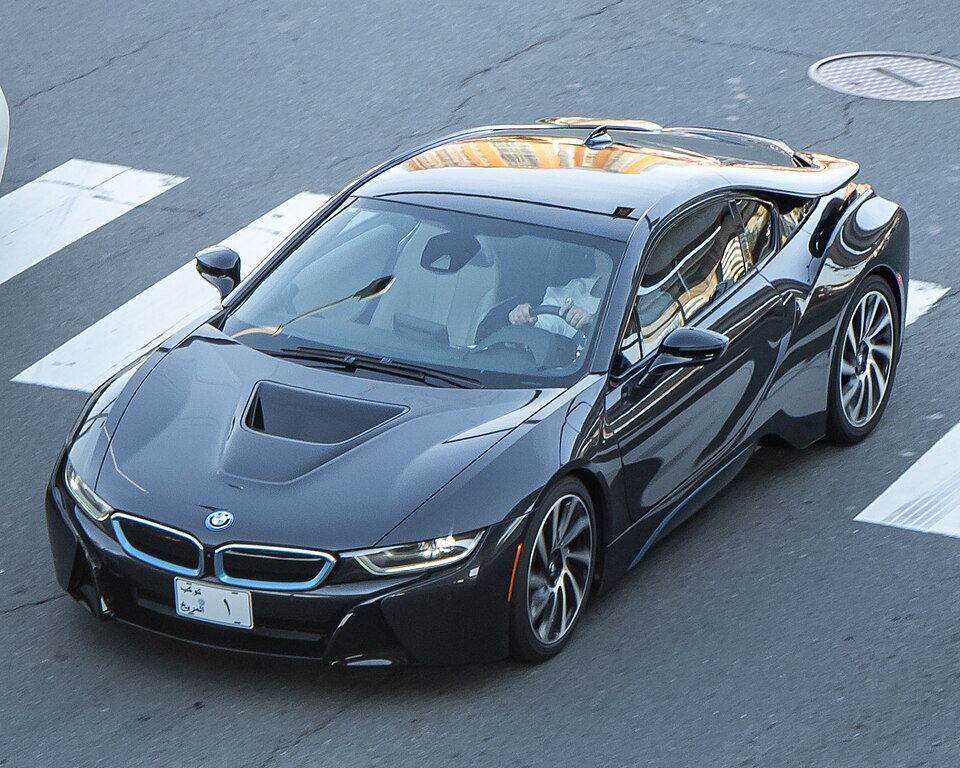
2019 BMW i8
The 2019 BMW i8 is sold in the U.S. as a plug-in hybrid convertible with 2 EPA-rated configurations. The most efficient version, the I8 Coupe, is EPA-rated at 27 mpg combined. NHTSA lists 2 recall campaigns for this model year, 1 rated critical, which gives it a Safety Signal grade of C.

Specs & fuel economy
Source: EPA fueleconomy.gov| Configuration | Powertrain | Drive | Engine / motor | City | Hwy | Comb | Range | kWh/100mi | Charge (240V) | Annual fuel* |
|---|---|---|---|---|---|---|---|---|---|---|
| I8 Coupe | Plug-in hybrid | AWD | 1.5L 3-cyl turbo + 96kW AC Induction | 26 | 29 | 27 (36 MPGe blended) | 18 mi electric | 49 | 3 h | $3,050 |
| I8 Roadster | Plug-in hybrid | AWD | 1.5L 3-cyl turbo + 96kW AC Induction | 26 | 29 | 27 (36 MPGe blended) | 18 mi electric | 49 | 3 h | $3,050 |
*EPA estimate at 15,000 miles/year at EPA reference fuel and electricity prices. fueleconomy.gov record ids: 40079, 40080.
Emissions & certification
Source: EPA emission certificates| Configuration | Smog rating | Emission standard | Where it can be sold new | SmartWay |
|---|---|---|---|---|
| I8 Coupe, I8 Roadster | 3 / 10 | California LEV-III ULEV125 / Federal Tier 3 Bin 125 | All 50 states (federal, all altitudes); California and states following California standards | SmartWay |
Certified for all fifty states, so it can be registered new anywhere in the U.S.
The smog rating scores tailpipe pollutants other than greenhouse gases, 1 (worst) to 10 (best), and is comparable only within a model year. The standard is the federal bin or California tier the configuration was certified to. Both come from the EPA certificate behind the window sticker.
Factory warranty running out?
The 2019 BMW i8 is in the years where high-voltage electronics and module repairs land on the owner. What an extended plan does and does not cover is worth reading before a dealer quotes you one.
What to check before you buy →Affiliate disclosure: some links on this page are affiliate links. If you request a quote or buy through them we may earn a commission at no extra cost to you. Nothing on this page changes because of it.
Recalls (2)
Source: NHTSA recall databaseEquipment
These are vehicle campaigns — the ones the automaker filed against this model. NHTSA also records equipment recalls, filed by a parts maker against a component (a tyre, a child seat, an aftermarket part), and those are not listed here or counted above. nhtsa.gov/recalls shows both for a VIN.
NHTSA defect investigations
Electrical System:Propulsion System — Pedestrian alert sounds closed
NHTSA received a petition on or about July 18, 2022, requesting that Federal Motor Vehicle Safety Standard (FMVSS) 141 be applied to all electric and hybrid vehicles operating in the United States. The petition can be reviewed at NHTSA.gov under ODI Number 11486072. FMVSS 141 establishes performance requirements for pedestrian alert sounds for motor vehicles. The standard applies to hybrid and electric vehicles that have a gross vehicle weight rating of 4,536 KG or less or are defined as low-speed vehicles. The standard became fully applicable to all such vehicles manufactured on or after March 1, 2021. On January 27, 2023, NHTSA opened Defect Petition (DP) 22-005 to evaluate the subject mat
Opened Jan 27, 2023 · closed Aug 7, 2023 · action DP22005 · the investigation’s page →
Air Bags:Frontal:Passenger Side:Inflator Module — Desiccated Air Bag Inflator Rupture open
From 2000 through 2017, Takata produced millions of air bag inflators using two types of phase-stabilized ammonium nitrate ("PSAN") propellant -- propellant 2004 and propellant 2004L. After prolonged exposure to high temperature cycles and humidity, inflators using propellant 2004 can degrade, causing the propellant to burn too quickly when ignited. The rapid burning can cause the inflator to rupture during deployment, potentially causing serious or even fatal injury to vehicle occupants. See 2016 Blomquist Report at www.nhtsa.gov/sites/nhtsa.gov/files/documents/expert_report-hrblomquist.pdf. Consequently, all frontal inflators using propellant 2004 that do not contain a "desiccant" (a subst
Opened Sep 17, 2021 · action EA21002 · the investigation’s page →
Whether any of this applies to one specific i8
A campaign covers a build range, not a model year, so two identical-looking cars from 2019 can differ. Both of these check a VIN against the manufacturer’s own list, free, in about ten seconds. BMW publishes its own lookup because federal rule 49 CFR 573.15 requires it to, and to keep it current to within seven days.
Hear about a recall before the letter does
The manufacturer’s letter is the last step of a recall: it has up to 60 days after filing to mail owners, at the address on the registration. We email you the day NHTSA posts a recall on the 2019 BMW i8, with what to do next. Nothing else, ever — no newsletter, no marketing, one-click unsubscribe in every message.
Parts & accessories for the 2019 BMW i8
Search by fitment on eBay Motors — OEM take-offs, aftermarket, and the trim pieces dealers no longer stock. The listing and the price are the seller's.
Find parts for this i8 →Owner complaints
Source: NHTSA complaint databaseNo owner complaints on file with NHTSA for this model year.
Crash ratings
Source: NHTSA NCAPNHTSA has not published 5-Star crash ratings for this model year.
Service bulletins & campaigns
Source: NHTSA manufacturer communications- 15 years or 150,000 miles · BMW warranty extension 1390900300For this vehicle, the EVAP systems purge (vent) valve limited warranty for defects in materials or workmanship has been extended to 15 years/150,000 miles, from the original 10 years/120,000 miles…
- 15 years or 150,000 miles · BMW warranty extension 6127900700The High-Voltage (HV) Battery Assembly Cell Modules Temperature Sensors (Internal NTC repair kit-specific) limited warranty for defects in materials or workmanship has been extended to 15 years…
The term and the vehicles it covers are the manufacturer’s, as NHTSA’s summary of each filing states them; a dealer checks one particular car by its VIN. Every BMW warranty extension (46) → · Every warranty extension on file, all makes →
Most often about: Equipment, Electrical System, Structure, Engine, Equipment Adaptive/Mobility.
- B011325 Warranty extension2026-05-07 · Engine
- The EVAP systems purge (vent) valve limited warranty for defects in materials and / or workmanship has been extended to 15 years / 150,000 miles as determined from the original first in-service / delivery date.
- B011124 Warranty extension2024-12-04 · Electrical System
- the High-Voltage (HV) Battery Assembly Cell Modules Temperature Sensors (Internal NTC repair kit-specific) limited warranty for defects in materials or workmanship has been extended to 15 years/150,000 miles as determined from the original in-service/first delivery date.
- B611305 Service bulletin2024-01-11 · Electrical System
- The electrical system of BMW vehicles has been subject to an ongoing development process over the last few years. This has led to increased demands being placed on the battery. This document covers important information for the dealer on how to handle “discharged battery” complaints.
- B360121 Service bulletin2024-01-08 · Steering
- At low outside temperatures (below 40 degrees F) and slow driving speeds (i.e. when parking, maneuvering)with a large steering angle, the front end can be slightly axially misaligned. This can be felt (jerking)/ heard via an acoustic acknowledgement (clunk) as seen at the 11 second mark of the video. See attached video V36 01 21.
- B840922 Service bulletin2022-09-01 · Equipment — Electrical
- Due to a production error, the telematics control units were delivered without an IMS configuration.
- SIB651312 Service bulletin2022-05-01 · Electrical System
- The Headunit High (HU-H), also called NBT, began replacing the Car Information Computer (CIC) on certain MY2013 vehicles with option 609 (as of 7/2012 production). This uses map North America NEXT. The Headunit High 2 (HU-H2), also called NBT-EVO, superseded the NBT HU and was introduced in 3/2014. This uses map North America EVO. The Headunit High 4 (HU-H4, also called MGU21) superseded the MGU s
- B651312 Service bulletin2021-09-01 · Equipment — Electrical — Navigational System(Global Positioning System)
- The Headunit High (HU-H), also called NBT, began replacing the Car Information Computer (CIC) on certain MY2013 vehicles with option 609 (as of 7/2012 production). This uses map North America NEXT. The Headunit High 2 (HU-H2), also called NBT-EVO, superseded the NBT HU and was introduced in 3/2014. This uses map North America EVO. The Headunit High 3 (HU-H3, also called MGU) superseded the NBT-EVO
- B840121 Service bulletin2021-05-01 · Equipment — Electrical
- TELEMATICS UNIT DEACTIVATION DUE TO 3G CELLULAR TECHNOLOGY DISCONTINUATION: The discontinuation of 3G cellular communication for Combox, TCB 3G and ATM 3G (Telematics ControlModule) can no longer be supported by the cellular network provider starting February 2022.
A service bulletin is the manufacturer telling its dealers how to diagnose or repair a known condition. It is not a recall, not a finding that the vehicle is defective, and the work is not automatically free — though a bulletin is often what a dealer works from when you describe a symptom, so quoting the document number can save a diagnosis. The count is every communication filed; the list shows the most recent, one entry per campaign, because a single campaign is usually filed as several documents on the same day. The summaries are NHTSA's; the full documents come from the manufacturer.
i8 by model year
all years, side by side →Common questions about the 2019 i8
Source: EPA, NHTSA and manufacturer press kitsDoes the 2019 BMW i8 have any recalls?
NHTSA has posted 2 recall campaigns for the 2019 BMW i8, 1 of them rated critical. The most serious on file is 18V652000, covering Equipment. Check your own VIN at nhtsa.gov/recalls; a recall applies to specific build ranges, not every car.
How safe is the 2019 BMW i8?
NHTSA has not published a crash-test rating for the 2019 BMW i8 yet. On the recall record WhichTrim grades it C (78/100), which measures open and severe recalls rather than crash protection.
What is the fuel economy of the 2019 BMW i8?
Across the 2 EPA-rated configurations of the 2019 BMW i8, the best EPA combined figure is 27 mpg (MPGe on the electrified versions). Figures are the EPA's own, per configuration, and every one is listed above.
How clean is the 2019 BMW i8?
The EPA smog rating for the 2019 BMW i8 is 3 out of 10. That score covers tailpipe pollutants other than greenhouse gases, and it only compares vehicles within the same model year. It is certified for all fifty states, so it can be registered new anywhere in the U.S. Its configurations were certified to different standards — California LEV-III ULEV125, Federal Tier 3 Bin 125 — which the table above lists per configuration.
Are there service bulletins for the 2019 BMW i8?
The manufacturer has filed 87 service bulletins and related communications with NHTSA for the 2019 BMW i8, most often covering equipment, electrical system, structure. The most recent is dated 2026-05-07. A bulletin is not a recall: it is the repair procedure a manufacturer sends its dealers for a condition it knows about, and the work is not automatically paid for. It is still worth knowing — if the symptom matches, quoting the bulletin number at the service desk can save a diagnosis. The document numbers and summaries are listed above.
What we hold, and what an empty row means
Paid vehicle-history reports will not tell you the difference between “nothing happened to this car” and “we never received that record” — both of the big two say as much in their own help pages. Most of what is on this page comes from complete federal registers, so we can tell you which is which, row by row.
| Data | Held | Source | What it covers — or what empty means |
|---|---|---|---|
| Fuel economy & configurations | 2 configurations | EPA certification records | Every configuration the EPA certified for sale, with its own test figures. |
| Emission certificates | 2 configurations | EPA emission certificates | Smog rating, standard and the sales area that decides where the car can be sold new. |
| Recalls | 2 | NHTSA recall campaigns | A complete federal register: every campaign covering this model year, with severity and advisory flags. |
| Owner complaints | none | NHTSA complaint database | No owner has filed one. On a car that sold in small numbers this says very little either way. |
| Crash ratings | none | NHTSA NCAP | NHTSA has not tested this model year. Cars are selected for testing, so untested is not unsafe. |
| Service bulletins | 87 | NHTSA manufacturer communications | Everything the manufacturer told its dealers about a defect or malfunction, short of a recall. |
| Investigations | 2 | NHTSA Office of Defects Investigation | Open and closed defect investigations, with the agency's own narrative. |
| Driver-assist crash reports | none | NHTSA Standing General Order 2021-01 | No report has been filed. Only entities named in the order report, and only crashes they hear of — so this is also what an unequipped car, or a manufacturer without telematics, looks like. |
| Specifications filed with NHTSA | none | NHTSA vPIC, decoded from VIN patterns | We had no VIN pattern to decode for this model year, or the manufacturer filed nothing usable. |
| Trims, pricing & equipment | none | Manufacturer press kit | We have not transcribed a press kit for this model year yet. This is our gap, not the manufacturer's — the one row here where an empty cell means we are behind. |
Rebuilt nightly; this page was generated 2026-10-26. Every figure above is traceable to the source named beside it, and the JSON for this page carries the same values with their identifiers.
Sources & method
Safety Signal starts every model-year at 100 and subtracts points per open NHTSA recall campaign by severity: critical 15 (fire risk, park-outside or do-not-drive advisories), high 8 (brakes, steering, airbags, loss of drive power, structure, battery), moderate 6, minor 3 (software, labels, lighting fixed by an update). The most serious recall counts in full and each further one counts 85% of the one before, because a vehicle sold in millions is recalled more often than a rare one without being more dangerous — and because a flat subtraction bottomed the scale out, scoring a vehicle with 22 recalls within a point of one with six. A ≥ 90, B ≥ 80, C ≥ 70, D ≥ 60, otherwise F. Read it as what it counts: recall campaigns on the federal record, weighted by severity. The damping reduces the sales bias by roughly 40% but does not remove it: like our complaint counts, this is not normalized by how many were sold, so a best-seller still scores somewhat worse than an obscure model with the same real risk. NHTSA crash ratings, do-not-drive and park-outside advisories, and the crash, fire, injury and death counts in owner complaints are reported separately on every page and never blended into the letter — a vehicle can hold five stars and a poor letter at once, and where that happens we say so rather than leave you to notice. Because the scale subtracts from a clean sheet, a model year too new to have been recalled, complained about or bulletined scores full marks on an empty record; we label those grades provisional rather than present them as earned.
EPA figures come from fueleconomy.gov vehicle records. Recalls, complaints, investigations and crash ratings come from NHTSA's public flat files, refreshed nightly.