HomeTeslaModel X › 2025

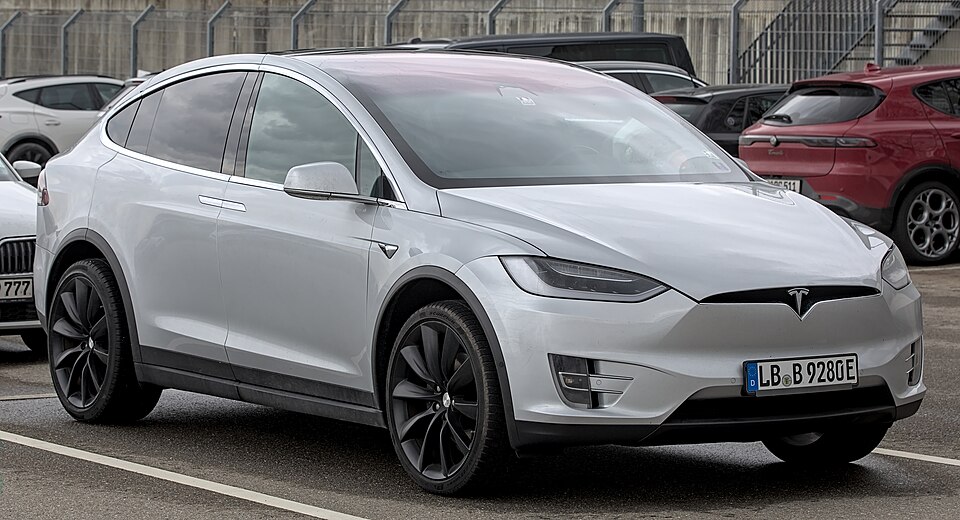
2025 Tesla Model X

Electric Midsize / large SUV

20262025202420232022202120202019201820172016
Specs & fuel economyRecallsComplaintsCrash ratings
C
Safety Signal
76 / 100
CSafety Signal · 76 / 100
3Recalls · NHTSA campaigns
15Complaints · owner reports
Crash rating · NHTSA overall
329 miEV range · best configuration

The 2025 Tesla Model X is sold in the U.S. as a electric midsize or large SUV with 3 EPA-rated configurations. Its longest-range version, the Model X, is EPA-rated at 329 miles with 98 MPGe combined efficiency. NHTSA lists 3 recall campaigns for this model year, which gives it a Safety Signal grade of C. Owners have filed 15 complaints, most often about unknown or other.

Specs & fuel economy (EPA)

ConfigurationPowertrainDriveEngine / motorCityHwyCombRangekWh/100miCharge (240V)Annual fuel*
Model XElectricAWD243 and 248 kW ACPM1039498 MPGe329 mi34.214 h$750
Model X Plaid (20in wheels)ElectricAWD230, 230 and 230 kW ACPM 3-Phase988994 MPGe314 mi35.914 h$800
Model X Plaid (22in wheels)ElectricAWD230, 230 and 230 kW ACPM 3-Phase928488 MPGe294 mi38.114 h$850

*EPA estimate at 15,000 miles/year and EPA reference fuel/electricity prices. Source: fueleconomy.gov vehicle records.

Insure it for less

Insurers price the 2025 Model X very differently. A two-minute comparison across 100+ carriers is the cheapest ownership win there is.

Compare insurance →

Affiliate disclosure: some links on this page are affiliate links. If you request a quote or buy through them we may earn a commission at no extra cost to you. Data on this page is never influenced by that.

Recalls (3)

Electrical System

high
91 vehicles

Problem: Tesla, Inc. (Tesla) is recalling certain 2021-2024 Model S and 2021-2025 Model X vehicles. An air bag with the incorrect horn pad may have been installed, preventing the horn from sounding.

Risk: An inoperative horn may prevent the driver from alerting other drivers, increasing the risk of a crash.

Fix: Tesla service will inspect and install an air bag with the correct horn pad as necessary, free of charge. Owner notification letters were mailed May 20, 2025. Owners may contact Tesla customer service at 1-877-798-3752. Tesla's number for this recall is SB-25-20-001.

NHTSA campaign 25V172000 · reported Mar 19, 2025 · Tesla, Inc.

Electrical System

high
239,382 vehicles

Problem: Tesla, Inc. (Tesla) is recalling certain 2024-2025 Model 3, Model S, 2023-2025 Model X, and Model Y vehicles. The computer circuit board may short, resulting in the loss of the rearview camera image. As such, these vehicles fail to comply with the requirements of Federal Motor Vehicle Safety Standard (FMVSS) number 111, "Rear Visibility."

Risk: A rearview camera that does not display an image reduces the driver's rear view, increasing the risk of a crash.

Fix: Tesla released an over-the-air (OTA) software update, free of charge. Tesla will also identify any vehicles that experienced a circuit board failure, or stress that may lead to a circuit board failure, and replace the affected computers, free of charge. Owner notification letters were mailed March 7, 2025. Owners may contact Tesla customer service at 1-877-798-3752. Tesla's number for this recall is SB-25-00-001.

NHTSA campaign 25V002000 · reported Jan 6, 2025 · Tesla, Inc.

Air Bags

high
487 vehicles

Problem: Tesla, Inc. (Tesla) is recalling certain 2021-2025 Model S and Model X vehicles. The driver's air bag could tear during deployment. As such, these vehicles fail to comply with the requirements of Federal Motor Vehicle Safety Standard (FMVSS) numbers 208, "Occupant Crash Protection" and 212, "Windshield Mounting."

Risk: A torn air bag may not adequately protect an occupant in a crash, increasing the risk of injury.

Fix: Tesla service will replace the air bag assembly, free of charge. Owner notification letters were mailed February 21, 2025. Owners may contact Tesla customer service at 1-877-798-3752. Tesla's number for this recall is SB-24-20-001.

NHTSA campaign 24V967000 · reported Dec 23, 2024 · Tesla, Inc.

NHTSA investigations

Electrical System:Adas — FSD Collisions in Reduced Roadway Visibility Conditions (open)

The Office of Defects Investigation (ODI) is opening this Engineering Analysis to evaluate Tesla’s Full Self Driving Beta and Full Self Driving (Supervised) (collectively, FSD) degradation detection system. The focus of this investigation will be to assess the system’s ability, when encountering reduced roadway visibility conditions, to detect degradation and alert the driver with sufficient time to respond. ODI will evaluate the performance of FSD in degraded roadway conditions and the updates or modifications by Tesla to the degradation detection system, including the timing, purpose, and capabilities of the updates, and Tesla’s assessment of their safety impact. Tesla’s FSD is an

Opened Mar 18, 2026 · action EA26002

Electrical System:Adas — Traffic safety violations while Full Self Driving ("FSD") is engaged (open)

The Office of Defects Investigation (“ODI�) is opening this Preliminary Evaluation (PE) to assess the scope, frequency, and potential safety consequences of FSD executing driving maneuvers that constitute traffic safety violations. This investigation concerns versions of FSD that Tesla has labeled as "FSD (Supervised)" and "FSD (Beta)." Tesla characterizes FSD as an SAE Level 2 partial automation system requiring a fully attentive driver who is engaged in the driving task at all times. Level 2 partial automation systems are designed to support and assist the driver in performing certain aspects of the driving task, requiring a driver to supervise and intervene as necessary.  The driver

Opened Oct 7, 2025 · action PE25012

Electrical System:Adas — Compliance with Standing General Order 2021-01 Reporting Requirements (open)

The Office of Defects Investigation (“ODI�) has identified numerous incident reports submitted by Tesla, Inc. (“Tesla�) in response to Standing General Order 2021-01 (the “SGO�), in which the reported crashes occurred several months or more before the dates of the reports. The majority of these reports involved crashes in which the Standing General Order in place at the time required a report to be submitted within one or five days of Tesla receiving notice of the crash. When the reports were submitted, Tesla submitted them in one of two ways. Many of the reports were submitted as part of a single batch, while others were submitted on a rolling basis. Preliminary engagement betwe

Opened Aug 20, 2025 · action AQ25002

Electrical System:Adas:Autonomous/Self Driving — Actually Smart Summon sessions resulting in low-speed impacts. (closed)

On January 6, 2025, the Office of Defects Investigations (ODI) opened Preliminary Evaluation 24003 (PE24033) to investigate Actually Smart Summon (Summon) sessions resulting in crashes during active sessions. According to Tesla, Summon is a short-distance SAE Level 2 system, controlled by the user from a cell phone within a certain distance and intended for use in parking lots and on private property. ODI analyzed complaint data provided by Tesla as well as complaints submitted to ODI from consumers to identify Summon incidents resulting in crashes. ODI's analysis indicates that almost all Summon reported crashes involved minor property damage claims with no reported incidents involving a vu

Opened Jan 6, 2025 · closed Apr 3, 2026 · action PE24033

Owner complaints

15 complaints filed

2 involved a crash, 0 a fire, 1 injuries, 0 deaths reported by owners.

Filed by year — 2025: 11 · 2026: 4

Most-cited components

  • Unknown Or Other — 5
  • Forward Collision Avoidance — 5
  • Electrical System — 3
  • Service Brakes — 2
  • Steering — 2
“The contact owns a 2025 Tesla Model X. The contact stated that after the latest update was pushed out, the speed regulation on the vehicle failed to function as intended. The contact stated that the speed regulation was set to "Standard Mode" and the vehicle accelerated to 70 MPH in a 55 MPH Zone. The contact stated th…”Jan 27, 2026 · Electrical System · NHTSA owner report
“I am writing to report and formally document a very serious and distressing safety incident involving my Tesla Model X that occurred for a second time, on [XXX]. While driving routinely into the parking garage at my workplace, my vehicle suddenly and violently stopped without warning. There were no obstacles, vehicles,…”Nov 7, 2025 · Service Brakes · NHTSA owner report
“My Tesla Model X was in Autopilot mode (v13.2.9) at the time of the incident. The vehicle’s advanced driver-assistance system was actively controlling steering and speed, while I remained attentive with my hands on the wheel I was closely monitoring the car’s operation but was not manually steering, braking, or acc…”Nov 2, 2025 · Forward Collision Avoidance · NHTSA owner report

Complaint counts are raw owner reports to NHTSA, not verified defects, and scale with how many were sold. Use them to spot patterns, not to rank.

Crash ratings

ConfigurationOverallFrontalSideRolloverRollover risk
SUV AWDnot ratednot ratednot rated★★★★★9%

NHTSA New Car Assessment Program. Standard driver-assist: forward collision warning, lane departure warning, automatic emergency braking.

Other Model X model years

A

2026 Model X

0 recalls · 6 complaints

F

2024 Model X

8 recalls · 26 complaints

F

2023 Model X

17 recalls · 192 complaints

F

2022 Model X

22 recalls · 125 complaints

F

2021 Model X

24 recalls · 40 complaints

F

2020 Model X

10 recalls · 127 complaints

F

2019 Model X

8 recalls · 100 complaints

F

2018 Model X

9 recalls · 191 complaints

F

2017 Model X

10 recalls · 268 complaints

F

2016 Model X

12 recalls · 446 complaints

Sources & method

Safety Signal starts every model-year at 100 and subtracts points per open NHTSA recall campaign by severity: critical 15 (fire risk, park-outside or do-not-drive advisories), high 8 (brakes, steering, airbags, loss of drive power, structure, battery), moderate 6, minor 3 (software, labels, lighting fixed by an update). Floor 35. A ≥ 90, B ≥ 80, C ≥ 70, D ≥ 60, otherwise F. Complaint counts and NHTSA crash ratings are shown separately and are not blended into the grade.

EPA figures come from fueleconomy.gov vehicle records (ids 49125, 48768, 48769). Recalls, complaints, investigations and crash ratings come from NHTSA's public flat files, refreshed weekly.

JSON for this page · API