2023 Tesla Cybertruck
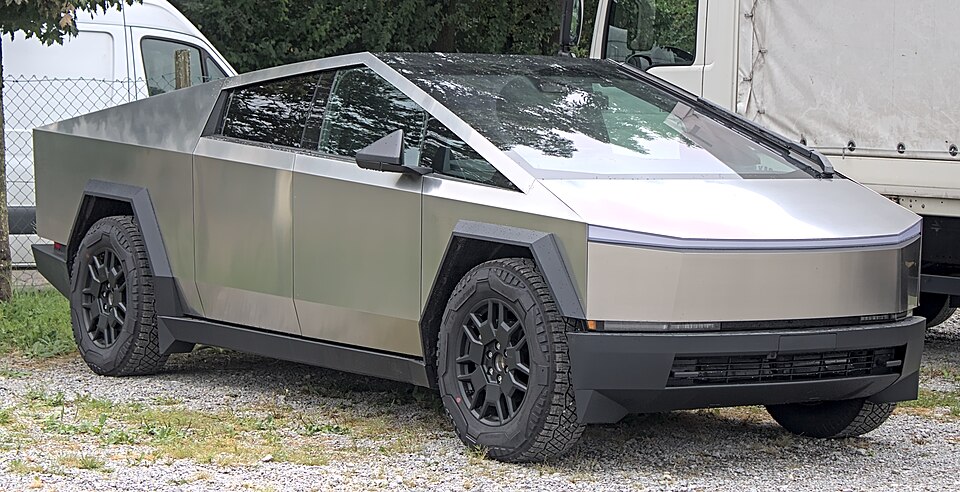
The 2023 Tesla Cybertruck is a large pickup truck; vehicles over 8,500 lb GVWR are not certified for fuel economy by the EPA, so this page is built from NHTSA's recall, complaint and investigation records. NHTSA lists no recall campaigns for this model year so far (Safety Signal A).

Specs & fuel economy
Source: EPA fueleconomy.govNo EPA fuel-economy record: the EPA does not certify vehicles over 8,500 lb GVWR. Recall, complaint and investigation data below come from NHTSA.
Factory warranty running out?
The 2023 Tesla Cybertruck is in the years where transmission, electronics and drivetrain repairs land on the owner. What an extended plan does and does not cover is worth reading before a dealer quotes you one.
What to check before you buy →Affiliate disclosure: some links on this page are affiliate links. If you request a quote or buy through them we may earn a commission at no extra cost to you. Nothing on this page changes because of it.
Recalls (0)
Source: NHTSA recall databaseNo NHTSA recall campaigns are on file for the 2023 Tesla Cybertruck. New campaigns appear here within a week of NHTSA posting them.
These are vehicle campaigns — the ones the automaker filed against this model. NHTSA also records equipment recalls, filed by a parts maker against a component (a tyre, a child seat, an aftermarket part), and those are not listed here or counted above.
NHTSA defect investigations
Electrical System:Adas — FSD Collisions in Reduced Roadway Visibility Conditions open
The Office of Defects Investigation (ODI) is opening this Engineering Analysis to evaluate Tesla’s Full Self Driving Beta and Full Self Driving (Supervised) (collectively, FSD) degradation detection system. The focus of this investigation will be to assess the system’s ability, when encountering reduced roadway visibility conditions, to detect degradation and alert the driver with sufficient time to respond. ODI will evaluate the performance of FSD in degraded roadway conditions and the updates or modifications by Tesla to the degradation detection system, including the timing, purpose, and capabilities of the updates, and Tesla’s assessment of their safety impact. Tesla’s FSD is an advanced
Opened Mar 18, 2026 · action EA26002 · the investigation’s page →
Electrical System:Adas — Traffic safety violations while Full Self Driving ("FSD") is engaged open
The Office of Defects Investigation (“ODI”) is opening this Preliminary Evaluation (PE) to assess the scope, frequency, and potential safety consequences of FSD executing driving maneuvers that constitute traffic safety violations. This investigation concerns versions of FSD that Tesla has labeled as "FSD (Supervised)" and "FSD (Beta)." Tesla characterizes FSD as an SAE Level 2 partial automation system requiring a fully attentive driver who is engaged in the driving task at all times. Level 2 partial automation systems are designed to support and assist the driver in performing certain aspects of the driving task, requiring a driver to supervise and intervene as necessary. The driver remains
Opened Oct 7, 2025 · action PE25012 · the investigation’s page →
Electrical System:Adas — FSD Collisions in Reduced Roadway Visibility Conditions closed
On October 17, 2024, NHTSA’s Office of Defects Investigation (ODI) opened a Preliminary Evaluation (PE24031) of Tesla’s Full Self Driving Beta and Full Self Driving (Supervised) (collectively, FSD) to assess: the ability of the FSD system to detect and respond appropriately to reduced roadway visibility conditions; whether any other FSD crashes had occurred under degraded roadway visibility conditions that are similar in nature to the four SGO-reported crashes identified in the opening document, and if so, the contributing circumstances for each of those crashes; and any updates or modifications by Tesla to the FSD system that may affect the performance of FSD in degraded roadway visibility
Opened Oct 17, 2024 · closed Mar 18, 2026 · action PE24031 · the investigation’s page →
Hear about a recall before the letter does
The manufacturer’s letter is the last step of a recall: it has up to 60 days after filing to mail owners, at the address on the registration. We email you the day NHTSA posts a recall on the 2023 Tesla Cybertruck, with what to do next. Nothing else, ever — no newsletter, no marketing, one-click unsubscribe in every message.
Parts & accessories for the 2023 Tesla Cybertruck
Search by fitment on eBay Motors — OEM take-offs, aftermarket, and the trim pieces dealers no longer stock. The listing and the price are the seller's.
Find parts for this Cybertruck →Owner complaints
Source: NHTSA complaint databaseNo owner complaints on file with NHTSA for this model year.
Crash ratings
Source: NHTSA NCAPNHTSA has not published 5-Star crash ratings for this model year.
Service bulletins & campaigns
Source: NHTSA manufacturer communicationsMost often about: Steering.
- SB-24-32-002 Service bulletin2024-04-08 · Steering
- On certain Cybertruck vehicles, the Steering Column Control Module (SCCM) does not meet Tesla quality standards.
A service bulletin is the manufacturer telling its dealers how to diagnose or repair a known condition. It is not a recall, not a finding that the vehicle is defective, and the work is not automatically free — though a bulletin is often what a dealer works from when you describe a symptom, so quoting the document number can save a diagnosis. The count is every communication filed; the list shows the most recent, one entry per campaign, because a single campaign is usually filed as several documents on the same day. The summaries are NHTSA's; the full documents come from the manufacturer.
Cybertruck by model year
all years, side by side →Common questions about the 2023 Cybertruck
Source: EPA, NHTSA and manufacturer press kitsDoes the 2023 Tesla Cybertruck have any recalls?
No NHTSA recall campaigns are on file for the 2023 Tesla Cybertruck. New campaigns appear here within a week of NHTSA posting them, and a clean sheet on a recent model year often just means the vehicle is new.
How safe is the 2023 Tesla Cybertruck?
NHTSA has not published a crash-test rating for the 2023 Tesla Cybertruck yet. On the recall record WhichTrim grades it A (100/100), which measures open and severe recalls rather than crash protection.
Are there service bulletins for the 2023 Tesla Cybertruck?
The manufacturer has filed 1 service bulletin and related communication with NHTSA for the 2023 Tesla Cybertruck, most often covering steering. The most recent is dated 2024-04-08. A bulletin is not a recall: it is the repair procedure a manufacturer sends its dealers for a condition it knows about, and the work is not automatically paid for. It is still worth knowing — if the symptom matches, quoting the bulletin number at the service desk can save a diagnosis. The document numbers and summaries are listed above.
What we hold, and what an empty row means
Paid vehicle-history reports will not tell you the difference between “nothing happened to this car” and “we never received that record” — both of the big two say as much in their own help pages. Most of what is on this page comes from complete federal registers, so we can tell you which is which, row by row.
| Data | Held | Source | What it covers — or what empty means |
|---|---|---|---|
| Fuel economy & configurations | none | EPA certification records | The EPA does not certify vehicles rated over 8,500 lb GVWR, so heavy-duty nameplates have no entry at all. |
| Emission certificates | none | EPA emission certificates | The EPA published no certificate we could match to a configuration on this page. |
| Recalls | none | NHTSA recall campaigns | No campaign has been filed. Because the register is complete, an empty row here means there is nothing to find — not that we are missing it. |
| Owner complaints | none | NHTSA complaint database | No owner has filed one. On a car that sold in small numbers this says very little either way. |
| Crash ratings | none | NHTSA NCAP | NHTSA has not tested this model year. Cars are selected for testing, so untested is not unsafe. |
| Service bulletins | 1 | NHTSA manufacturer communications | Everything the manufacturer told its dealers about a defect or malfunction, short of a recall. |
| Investigations | 3 | NHTSA Office of Defects Investigation | Open and closed defect investigations, with the agency's own narrative. |
| Driver-assist crash reports | none | NHTSA Standing General Order 2021-01 | No report has been filed. Only entities named in the order report, and only crashes they hear of — so this is also what an unequipped car, or a manufacturer without telematics, looks like. |
| Specifications filed with NHTSA | none | NHTSA vPIC, decoded from VIN patterns | We had no VIN pattern to decode for this model year, or the manufacturer filed nothing usable. |
| Trims, pricing & equipment | none | Manufacturer press kit | We have not transcribed a press kit for this model year yet. This is our gap, not the manufacturer's — the one row here where an empty cell means we are behind. |
Rebuilt nightly; this page was generated 2026-11-04. Every figure above is traceable to the source named beside it, and the JSON for this page carries the same values with their identifiers.
Sources & method
Safety Signal starts every model-year at 100 and subtracts points per open NHTSA recall campaign by severity: critical 15 (fire risk, park-outside or do-not-drive advisories), high 8 (brakes, steering, airbags, loss of drive power, structure, battery), moderate 6, minor 3 (software, labels, lighting fixed by an update). The most serious recall counts in full and each further one counts 85% of the one before, because a vehicle sold in millions is recalled more often than a rare one without being more dangerous — and because a flat subtraction bottomed the scale out, scoring a vehicle with 22 recalls within a point of one with six. A ≥ 90, B ≥ 80, C ≥ 70, D ≥ 60, otherwise F. Read it as what it counts: recall campaigns on the federal record, weighted by severity. The damping reduces the sales bias by roughly 40% but does not remove it: like our complaint counts, this is not normalized by how many were sold, so a best-seller still scores somewhat worse than an obscure model with the same real risk. NHTSA crash ratings, do-not-drive and park-outside advisories, and the crash, fire, injury and death counts in owner complaints are reported separately on every page and never blended into the letter — a vehicle can hold five stars and a poor letter at once, and where that happens we say so rather than leave you to notice. Because the scale subtracts from a clean sheet, a model year too new to have been recalled, complained about or bulletined scores full marks on an empty record; we label those grades provisional rather than present them as earned.
EPA figures come from fueleconomy.gov vehicle records. Recalls, complaints, investigations and crash ratings come from NHTSA's public flat files, refreshed nightly.