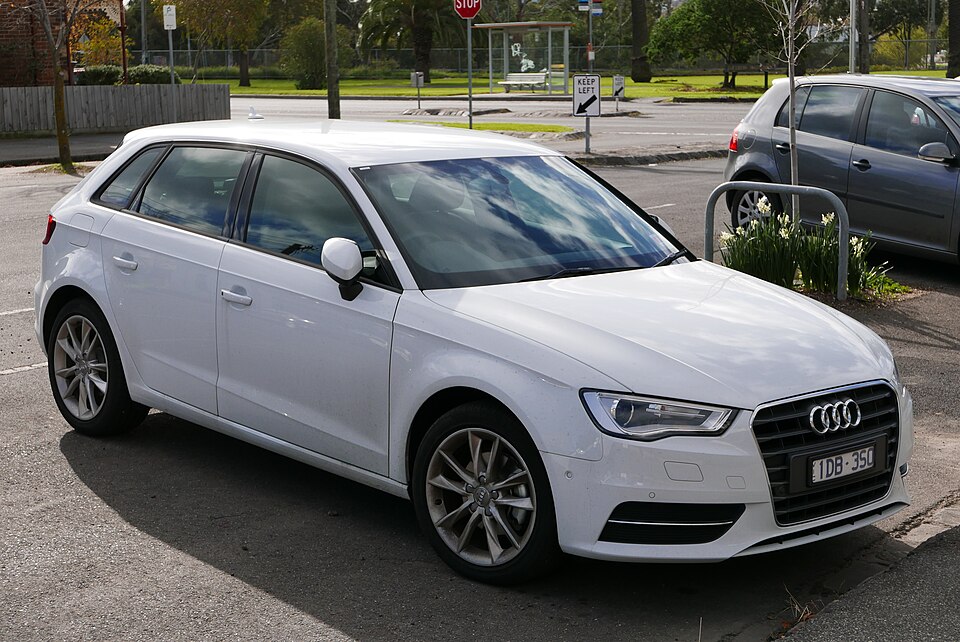
2016 Audi A3
Plug-in hybrid Gas Compact car
The 2016 Audi A3 is sold in the U.S. as a plug-in hybrid and gas compact car with 6 EPA-rated configurations. The most efficient version, the A3 e-tron ultra, is EPA-rated at 39 mpg combined. NHTSA lists 6 recall campaigns for this model year, 2 rated critical, which gives it a Safety Signal grade of F. Owners have filed 117 complaints, most often about air bags. NHTSA crash-tested it at 5 stars overall.
Specs & fuel economy (EPA)
| Configuration | Powertrain | Drive | Engine / motor | City | Hwy | Comb | Range | kWh/100mi | Charge (240V) | Annual fuel* |
|---|---|---|---|---|---|---|---|---|---|---|
| A3 e-tron ultra | Plug-in hybrid | FWD | 1.4L 4-cyl turbo + 80 kW DCPM | 37 | 41 | 39 (49 MPGe blended) | 17 mi electric | 38 | 2.5 h | $2,000 |
| A3 e-tron | Plug-in hybrid | FWD | 1.4L 4-cyl turbo + 80 kW DCPM | 33 | 37 | 35 (44 MPGe blended) | 16 mi electric | 40 | 2.5 h | $2,200 |
| A3 Cabriolet | Gas | FWD | 1.8L 4-cyl turbo | 24 | 35 | 28 | — | — | — | $2,250 |
| A3 | Gas | FWD | 1.8L 4-cyl turbo | 23 | 33 | 27 | — | — | — | $2,300 |
| A3 quattro | Gas | AWD | 2.0L 4-cyl turbo | 24 | 33 | 27 | — | — | — | $2,300 |
| A3 Cabriolet quattro | Gas | AWD | 2.0L 4-cyl turbo | 23 | 32 | 26 | — | — | — | $2,400 |
*EPA estimate at 15,000 miles/year and EPA reference fuel/electricity prices. Source: fueleconomy.gov vehicle records.
Out of factory warranty soon?
The 2016 Audi A3 is in the years where high-voltage electronics and module repairs land on the owner. Compare extended-coverage quotes in about two minutes.
Compare coverage →Affiliate disclosure: some links on this page are affiliate links. If you request a quote or buy through them we may earn a commission at no extra cost to you. Data on this page is never influenced by that.
Recalls (6)
Fuel System, Gasoline
criticalProblem: Volkswagen Group of America, Inc. (Volkswagen) is recalling certain front-wheel drive 2015-2020 Audi A3 Sedan, 2015-2019 Audi A3 Cabriolet, 2019-2020 Volkswagen Jetta GLI, 2018 Golf Sportwagen GP, 2018-2019 Golf Sportwagen A7, 2015-2017 Golf Sportwagen, 2015-2020 Golf GTI, and 2015-2020 Golf A7 vehicles. Due to a problem with a suction jet pump seal inside the fuel tank, fuel may flow into the evaporative emissions (EVAP) system and possibly leak out of the charcoal canister.
Risk: A fuel leak in the presence of an ignition source increases the risk of a fire.
Fix: Dealers will replace the suction pump, free of charge. Final owner notification letters for Audi owners were mailed on July 25, 2024. Final owner letters for VW owners were mailed on August 13, 2024. Owners may contact Volkswagen customer service at 1-800-893-5298 or Audi customer service at 1-800-253-2834. Volkswagen's numbers for this recall are VW: 20UF/Audi: 20YF. Vehicles that were previously recalled under 16V-647 will need to have the new remedy completed. This recall expands and re
Air Bags
highProblem: Volkswagen Group of America, Inc. (Volkswagen) is recalling certain 2016 Audi TT Roadster, TT Coupe, S3 Sedan, R8 Coupe, A3 Sedan, A3 Etron, A3 Cabriolet, 2016 Golf Sportwagen, Golf R, Golf GTI, Golf A7, and E Golf vehicles. During air bag deployment, the front passenger air bag may explode or deploy improperly.
Risk: An inflator explosion may result in sharp metal fragments striking occupants, resulting in serious injury or death. An improper air bag deployment may not properly restrain the occupant, increasing their risk of injury in a crash.
Fix: Dealers will replace the front-passenger air bag module, free of charge. Owner notification letters were mailed December 16, 2022. Owners may contact Volkswagen's customer service at 1-800-893-5298. Audi's customer service at 1-800-253-2834. Volkswagen's number for this recall is 69DY and 61C1.
Air Bags
highProblem: Volkswagen Group of America, Inc. (Audi) is recalling certain 2015-2020 Audi S3 Sedan, A3 Sedan, 2016-2018 A3 Etron, 2017-2020 RS3 Sedan, and 2015-2019 A3 Cabriolet vehicles. The passenger occupant detection system (PODS) may malfunction and switch off the passenger air bag even when the seat is occupied.
Risk: A deactivated passenger air bag increases the risk of injury during a crash.
Fix: Dealers will replace the PODS sensor mat and update the PODS control module, free of charge. Owners letters were mailed December 23, 2021. Owners may contact Audi customer service at 1-800-253-2834. Audi's number for this recall is 69BY.
Air Bags
highProblem: Volkswagen Group of America, Inc. (Audi) is recalling certain 2015-2016 Audi S3 Sedan, 2015-2019 A3 Sedan and A3 Cabriolet, 2016-2018 A3 e-tron, and 2017-2019 RS3 vehicles. An improper electrical contact may cause the Passenger Occupant Detection System (PODS) to falsely detect a malfunction and deactivate the passenger air bag.
Risk: A deactivated passenger air bag increases the risk of injury during a crash.
Fix: Audi will notify owners, and dealers will replace the connector and reroute the cable, free of charge. The recall began September 12, 2019. Owners may contact Volkswagen customer service at 1-800-253-2834. Audi's number for this recall is 69Z4.
Engine And Engine Cooling
criticalProblem: Volkswagen Group of America, Inc. (Volkswagen) is recalling certain model year 2015-2016 Volkswagen Golf, Golf SportWagen, GTI, Audi A3 sedan and A3 Cabriolet vehicles. Due to a problem with the suction pump inside the fuel tank, fuel may flow into the evaporative emissions (EVAP) system.
Risk: As fuel accumulates in the EVAP system, it may leak out through the charcoal canister filter element. A fuel leak in the presence of an ignition source increases the risk of a fire.
Fix: Volkswagen will notify owners, and dealers will replace the suction pump, free of charge. The recall began November 2016. Volkswagen owners may contact Volkswagen customer service at 1-800-893-5298, Audi owners may contact Audi customer service at 1-800-253-2834. Volkswagen's numbers for this recall are 20Y6 and 20Y5. This recall has been fully superseded by recall 24V-110.
Electrical System
minorProblem: Volkswagen Group of America, Inc. (Volkswagen) is recalling certain model year 2016 TT roadster, A3 cabriolet, A3 sedan and A3 e-tron, 2016-2017 TT coupe, 2017 A4 sedan and Q7 and 2015-2017 Q3 vehicles. The affected vehicles may have been programmed with new software that inadvertently makes the side marker lights inoperative in conjunction with the parking lights or the headlights. As such, these vehicles fail to comply with the requirements of Federal Motor Vehicle Safety Standard (FMVSS) number 108, "Lamps, Reflective Devices, and Associated Equipment."
Risk: If the side marker lights do not illuminate, the vehicle may be less visible at night, increasing the risk of a crash.
Fix: Audi will notify owners, and dealers will upload revised software to correct the issue, free of charge. This recall began November 2016. Owners may contact Audi customer service at 1-800-253-2834. Volkswagen's number for this recall is 97CB.
NHTSA investigations
Fuel System, Gasoline — Fuel Leak due to Suction Jet Pump Failure within Fuel Tank (Remedy Effectiveness of Recall 16V647) (closed)
On December 12, 2023, the Office of Defects Investigations (ODI) opened RQ23-007 to investigate the remedy repair effectiveness and scope of Volkswagen (VW) recall 16V-647. Recall 16V-647 was issued on September 2, 2016, for a defective suction jet pump (SJP) inside the fuel tank. Failure of the SJP could lead to a fuel leak from the vehicle. This recall covered certain model year (MY) 2015-2016 Volkswagen Golf and Audi A3 passenger car vehicles. The recall remedy repair replaced SJP Version 1.0 with an improved version, Version 1.1. The SJP is designed to purge fuel from the evaporative emissions (EVAP) system. VW’s recall filing stated the SJP may have been damaged during assembly, which
Opened Dec 12, 2023 · closed Jul 1, 2024 · action RQ23007
Electrical System:Propulsion System — Pedestrian alert sounds (closed)
NHTSA received a petition on or about July 18, 2022, requesting that Federal Motor Vehicle Safety Standard (FMVSS) 141 be applied to all electric and hybrid vehicles operating in the United States. The petition can be reviewed at NHTSA.gov under ODI Number 11486072. FMVSS 141 establishes performance requirements for pedestrian alert sounds for motor vehicles. The standard applies to hybrid and electric vehicles that have a gross vehicle weight rating of 4,536 KG or less or are defined as low-speed vehicles. The standard became fully applicable to all such vehicles manufactured on or after March 1, 2021.On January 27, 2023, NHTSA opened Defect Petition (DP) 22-005 to evaluate the subject matt
Opened Jan 27, 2023 · closed Aug 7, 2023 · action DP22005
Owner complaints
117 complaints filed
3 involved a crash, 4 a fire, 1 injuries, 0 deaths reported by owners.
Filed by year — 2016: 3 · 2017: 8 · 2018: 3 · 2019: 5 · 2020: 11 · 2021: 24 · 2022: 24 · 2023: 11 · 2024: 14 · 2025: 11 · 2026: 3
Most-cited components
- Air Bags — 51
- Fuel/Propulsion System — 22
- Electrical System — 19
- Engine — 15
- Unknown Or Other — 11
Complaint counts are raw owner reports to NHTSA, not verified defects, and scale with how many were sold. Use them to spot patterns, not to rank.
Crash ratings
| Configuration | Overall | Frontal | Side | Rollover | Rollover risk |
|---|---|---|---|---|---|
| 4 DR AWD | ★★★★★ | ★★★★☆ | ★★★★★ | ★★★★☆ | 11% |
| 4 DR FWD | ★★★★★ | ★★★★☆ | ★★★★★ | ★★★★☆ | 11% |
NHTSA New Car Assessment Program.
Other A3 model years
2026 A3
0 recalls · 0 complaints
A2025 A3
0 recalls · 5 complaints
A2024 A3
0 recalls · 1 complaints
B2023 A3
2 recalls · 6 complaints
F2022 A3
6 recalls · 9 complaints
D2020 A3
3 recalls · 16 complaints
D2019 A3
4 recalls · 14 complaints
F2018 A3
7 recalls · 45 complaints
F2017 A3
5 recalls · 69 complaints
Sources & method
Safety Signal starts every model-year at 100 and subtracts points per open NHTSA recall campaign by severity: critical 15 (fire risk, park-outside or do-not-drive advisories), high 8 (brakes, steering, airbags, loss of drive power, structure, battery), moderate 6, minor 3 (software, labels, lighting fixed by an update). Floor 35. A ≥ 90, B ≥ 80, C ≥ 70, D ≥ 60, otherwise F. Complaint counts and NHTSA crash ratings are shown separately and are not blended into the grade.
EPA figures come from fueleconomy.gov vehicle records (ids 37130, 37129, 36384, 36383, 36385, 36386). Recalls, complaints, investigations and crash ratings come from NHTSA's public flat files, refreshed weekly.