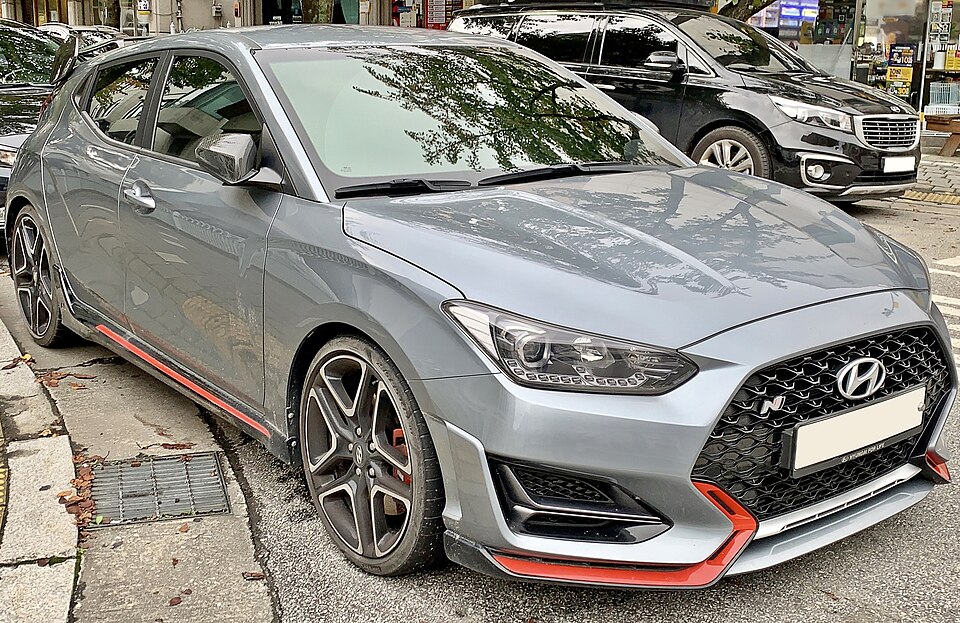
2020 Hyundai Veloster
Gas Compact car
The 2020 Hyundai Veloster is sold in the U.S. as a gas compact car with 5 EPA-rated configurations. The most efficient version, the Veloster, is EPA-rated at 30 mpg combined. NHTSA lists 2 recall campaigns for this model year, 1 rated critical, which gives it a Safety Signal grade of C. Owners have filed 26 complaints, most often about engine.
Specs & fuel economy (EPA)
| Configuration | Powertrain | Drive | Engine / motor | City | Hwy | Comb | Annual fuel* |
|---|---|---|---|---|---|---|---|
| Veloster | Gas | FWD | 2.0L 4-cyl | 27 | 34 | 30 | $2,100 |
| Veloster | Gas | FWD | 1.6L 4-cyl turbo | 28 | 34 | 30 | $2,100 |
| Veloster | Gas | FWD | 1.6L 4-cyl turbo | 26 | 33 | 29 | $2,150 |
| Veloster | Gas | FWD | 2.0L 4-cyl | 25 | 33 | 28 | $2,250 |
| Veloster N | Gas | FWD | 2.0L 4-cyl turbo | 22 | 29 | 25 | $3,100 |
*EPA estimate at 15,000 miles/year and EPA reference fuel/electricity prices. Source: fueleconomy.gov vehicle records.
Out of factory warranty soon?
The 2020 Hyundai Veloster is in the years where transmission, electronics and drivetrain repairs land on the owner. Compare extended-coverage quotes in about two minutes.
Compare coverage →Affiliate disclosure: some links on this page are affiliate links. If you request a quote or buy through them we may earn a commission at no extra cost to you. Data on this page is never influenced by that.
Recalls (2)
Fuel System, Gasoline
highProblem: Hyundai Motor America (Hyundai) is recalling certain 2019-2022 Veloster N, 2019-2023 Genesis G70, 2022-2023 Elantra N, and Kona N vehicles. The fuel pump may fail, which can result in a loss of drive power.
Risk: A loss of drive power can increase the risk of a crash.
Fix: Dealers will update engine control module software. In addition, dealers will inspect and replace the fuel pump assembly, as necessary. All repairs will be performed free of charge. Owner notification letters were mailed beginning September 9, 2024. Some interim notification letters, notifying owners of the safety risk, were mailed September 3, 2024. Owners may contact Hyundai customer service at 1-855-371-9460. Hyundai's numbers for this recall are 262 and 023G.
Engine
criticalProblem: Hyundai Motor America (Hyundai) is recalling certain 2019-2020 Elantra, 2019-2021 Kona and Veloster vehicles equipped with 2.0L Nu MPI engines. The piston oil rings may not have been properly heat-treated, which could result in engine damage.
Risk: A damaged engine may stall, increasing the risk of a crash. In addition, oil may leak onto hot exhaust components, increasing the risk of a fire.
Fix: Dealers will inspect and, if necessary, replace the engine, free of charge. In addition, Hyundai will deploy Piston Ring Noise Sensing System (PNSS) software. Owner notification letters were mailed August 24, 2021. Owners may contact Hyundai customer service at 1-855-371-9460.
Owner complaints
26 complaints filed
0 involved a crash, 0 a fire, 0 injuries, 0 deaths reported by owners.
Filed by year — 2020: 2 · 2021: 9 · 2022: 3 · 2023: 1 · 2024: 3 · 2025: 7 · 2026: 1
Most-cited components
- Engine — 8
- Unknown Or Other — 6
- Steering — 5
- Structure — 2
- Power Train — 2
Complaint counts are raw owner reports to NHTSA, not verified defects, and scale with how many were sold. Use them to spot patterns, not to rank.
Crash ratings
NHTSA has not published 5-Star crash ratings for this model year.
Other Veloster model years
2022 Veloster
2 recalls · 36 complaints
D2021 Veloster
3 recalls · 29 complaints
D2019 Veloster
3 recalls · 45 complaints
A2017 Veloster
0 recalls · 49 complaints
B2016 Veloster
1 recalls · 221 complaints
Sources & method
Safety Signal starts every model-year at 100 and subtracts points per open NHTSA recall campaign by severity: critical 15 (fire risk, park-outside or do-not-drive advisories), high 8 (brakes, steering, airbags, loss of drive power, structure, battery), moderate 6, minor 3 (software, labels, lighting fixed by an update). Floor 35. A ≥ 90, B ≥ 80, C ≥ 70, D ≥ 60, otherwise F. Complaint counts and NHTSA crash ratings are shown separately and are not blended into the grade.
EPA figures come from fueleconomy.gov vehicle records (ids 41381, 41383, 41384, 41382, 41385). Recalls, complaints, investigations and crash ratings come from NHTSA's public flat files, refreshed weekly.